
 Germany
Hohlenstein-Stadel is a cave located in the Hohlenstein cliff (not to be confused with the Hohle Fels) at the southern rim of the Lonetal in the Swabian Jura in Germany [1]. The most significant finding was a small ivory statue called the Löwenmensch, which is one of the oldest pieces of figurative art ever found [1]. The first excavations at Hohlenstein were made in 1861 by Oskar Fraas, geologist and paleontologist [1]. On 27 August 1937, excavators discovered the right femur diaphysis, measuring around 25 cm in length, of an archaic hominin in the cave [1]. The femur came from a layer associated with Middle Paleolithic Mousterian artefacts [1]. In 2017, researchers successfully sequenced the full mtDNA genome from the femur [1]. The results confirmed that the femur belonged to a Neanderthal [1].
Text: Wikipedia – 'Hohlenstein-Stadel' (revision of 2026-09-09), CC BY-SA 4.0 · sentences selected and shortened by an AI system · source →Hohlenstein-Stadel
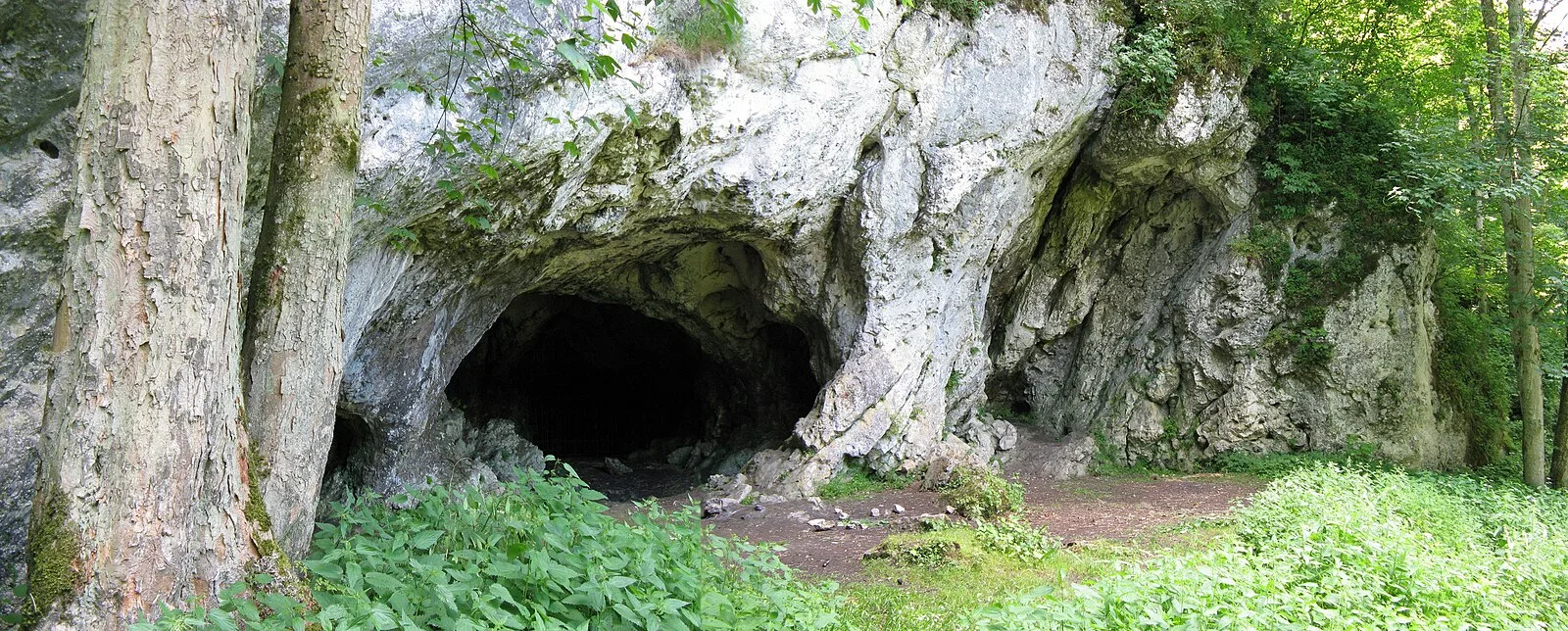
Also known as: Hohlenstein-Stadel (arula), Холенштайн-Штадель, هولنشتاين ستادل, هولنشتاين-ستادل, ホーレンシュタイン・シュターデル, ホーレンシュタイン=シュターデル, 霍伦斯坦岩棚
| Type | Cave Structures |
|---|---|
| Period | < 4500 BC |
| Country | Germany |
| Coordinates | 48.5492° N, 10.1725° E |