
 England
Chanctonbury Ring is a prehistoric hill fort atop Chanctonbury Hill on the South Downs, on the border of the civil parishes of Washington and Wiston in the English county of West Sussex [1]. Consisting of a roughly circular low earthen rampart surrounded by a ditch, Chanctonbury Ring is thought to date to the late Bronze Age or early Iron Age [1]. The hill fort is roughly circular, enclosing about 1.5 hectares (3.7 acres) [1]. Chanctonbury Ring was investigated by archeologists in excavations carried out in 1869, 1909, 1977 and 1988–91 [1]. Evidence for human activity in the Neolithic and early Bronze Age has been found, but not settlement or occupation [1]. Around five hundred years after its initial abandonment, Chanctonbury Ring was reused as a religious site from the mid-first century AD [1]. At least two Romano-Celtic temples were built in the interior, probably some time during the second century, while the bank and ditch were reused to form a temenos or "sacred precinct" [1]. Mosaic fragments from Chanctonbury Ring can be found at the Horsham Museum [1].
Text: Wikipedia – 'Chanctonbury Ring' (revision of 2026-05-22), CC BY-SA 4.0 · sentences selected and shortened by an AI system · source →Chanctonbury Ring
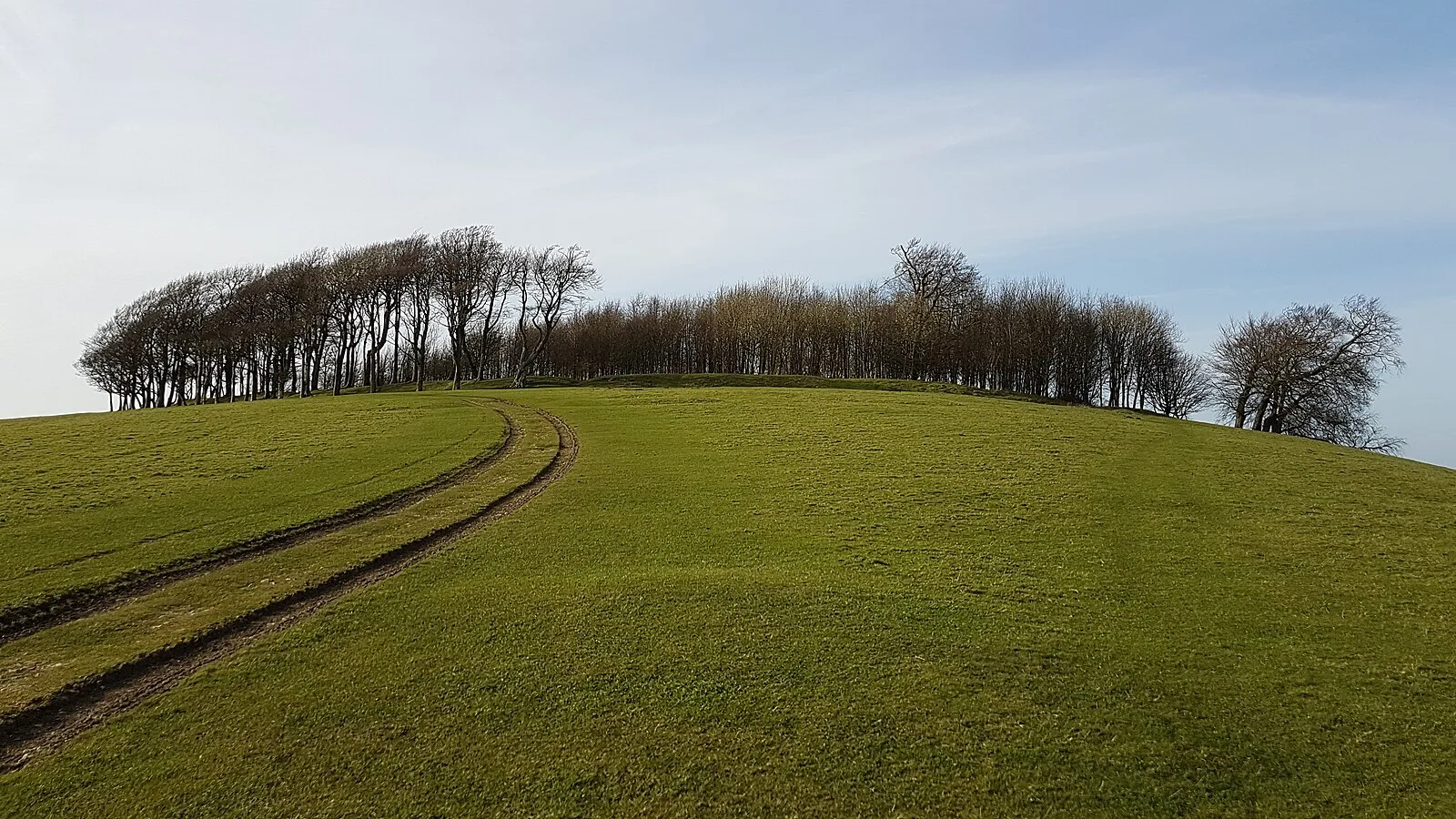
Also known as: جبل تشانكتونبورى رينج, チャンクトンベリリング
| Type | Fortress/citadel |
|---|---|
| Period | 1500 - 500 BC |
| Country | England |
| Coordinates | 50.8964° N, 0.3817° W |