
 England
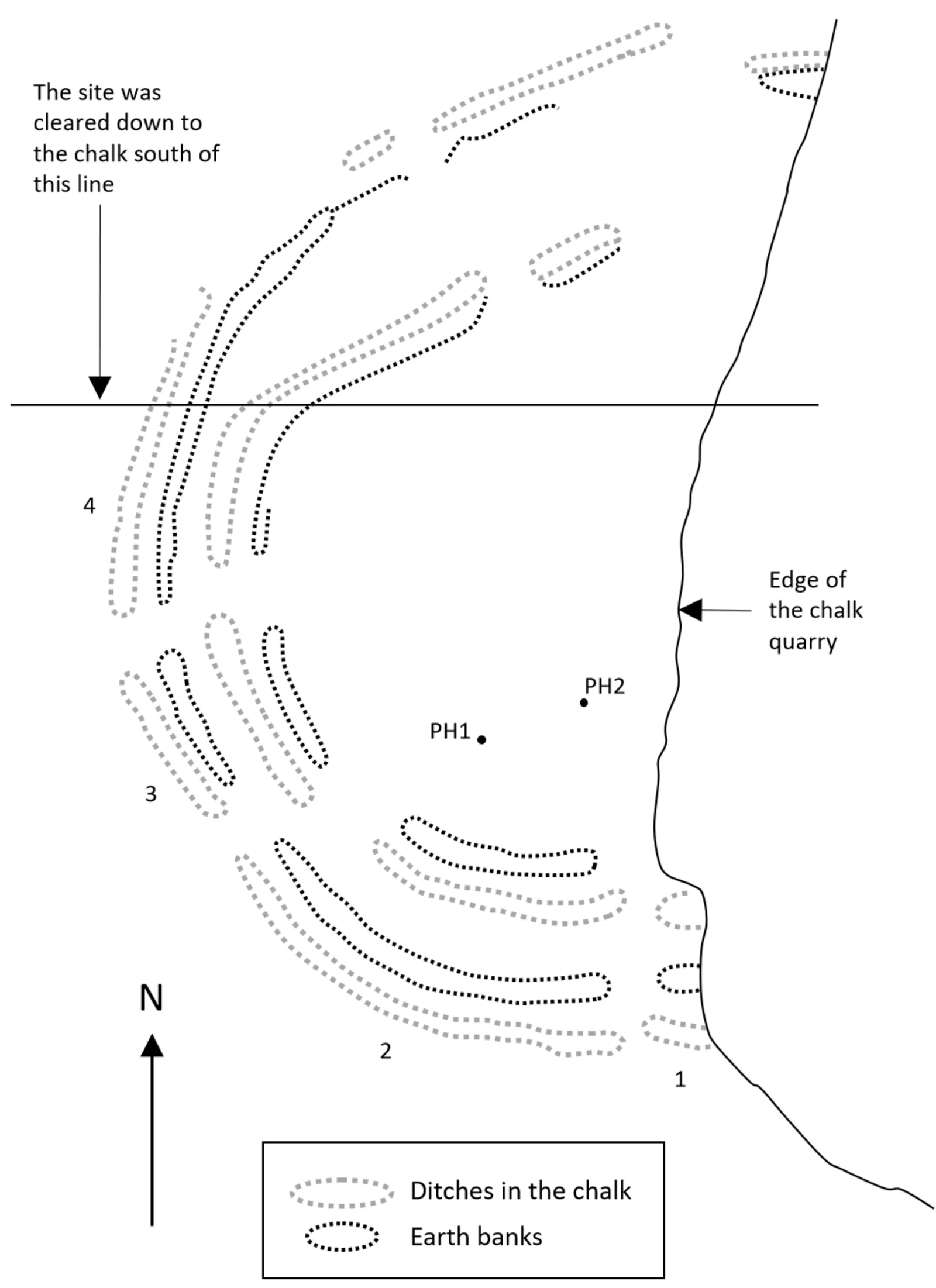
Offham Hill is a causewayed enclosure near Lewes, East Sussex, England [1]. The Ordnance Survey inspected the site in 1972 and recommended an excavation, which was carried out in 1976 by Peter Drewett [1]. The majority of Drewett's finds came from the ditches, including about 7,000 worked flints, nearly 300 sherds of pottery, a human burial, other human bone, and animal remains [1]. Most of the pottery was identified as Neolithic, and radiocarbon dating of charcoal found in one of the ditches confirmed that the enclosure dated to the Neolithic [1]. A reanalysis of the radiocarbon dates in 2011 concluded that the enclosure was constructed in the mid-fourth millennium BC [1]. The site is on the north face of Offham Hill, above the Ouse valley, on the edge of the South Downs, north of Lewes [1]. The eastern part of the site was completely destroyed by a chalk quarry during the 19th century [1].
Text: Wikipedia – 'Offham Hill' (revision of 2026-07-19), CC BY-SA 4.0 · sentences selected and shortened by an AI system · source →Offham Hill
Also known as: Causewayed enclosure on Offham Hill, Offham Hill Causewayed Enclosure, آفهم هیل
| Type | Earthwork |
|---|---|
| Period | 4500 - 3000 BC |
| Country | England |
| Coordinates | 50.8873° N, 0.0134° W |