
 England
Fishbourne Roman Palace or Fishbourne Villa is in the village of Fishbourne, near Chichester in West Sussex [1]. Extensive alterations were made in the second and third centuries AD, when many of the original black and white mosaics were overlaid with more sophisticated coloured work [1]. The site was accidentally discovered in 1805 [1]. Workers discovered 13-foot-wide pavement as well as fragments of columns [1]. The first buildings on the site were granaries, over 33 m long, apparently a supply base for the Roman army constructed in the early part of the conquest in 43 AD [1]. Later, two residential timber-frame buildings were constructed, one with clay and mortar floors and plaster walls which appears to have been a house of some comfort [1]. These buildings were demolished around 60 AD and replaced nearby with an elaborate and substantial stone-walled villa, or proto-palace, in about 65 AD which included a courtyard garden with colonnades and a bath suite, together with two other buildings [1]. It was decorated with wall paintings, stucco mouldings and opus sectile marble polychrome panels [1].
Text: Wikipedia – 'Fishbourne Roman Palace' (revision of 2026-09-07), CC BY-SA 4.0 · sentences selected and shortened by an AI system · source →Fishbourne Roman Palace
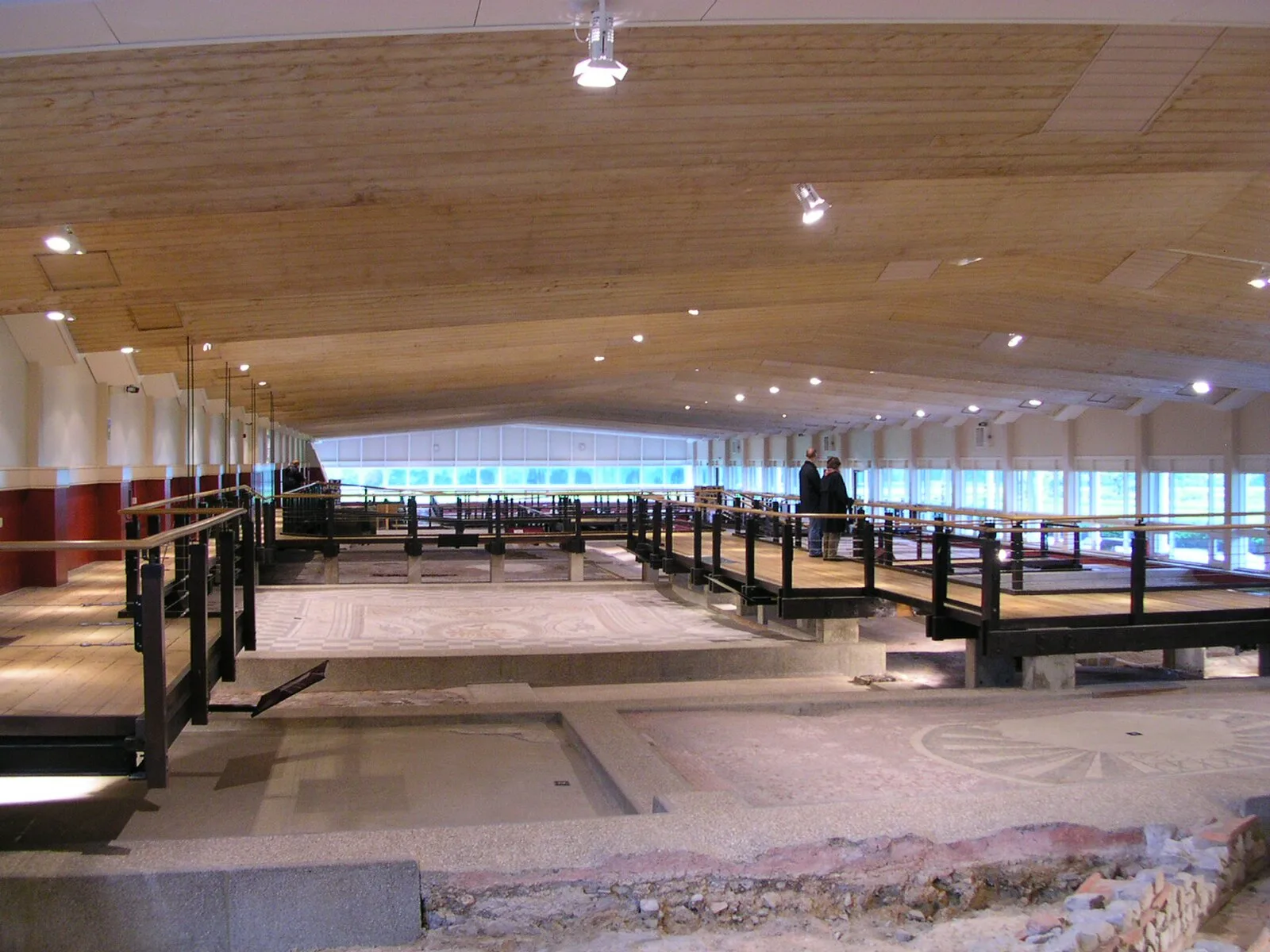
Also known as: Det romerske palass i Fishbourne, Fishbourne, Fishbourne Aula, Fishbourne (palaco), Fishbournska rimska palača, Palacio romano de Fishbourne, palais romain de Fishbourne, Palau romà de Fishbourne, Palazzo romano di Fishbourne, Villa Romana ad Fishbourne, פישבורן, قصر فيشبورن
| Type | Residence/villa/farmhouse |
|---|---|
| Period | 1 - 500 AD |
| Country | England |
| Coordinates | 50.8368° N, 0.8103° W |