
 Germany
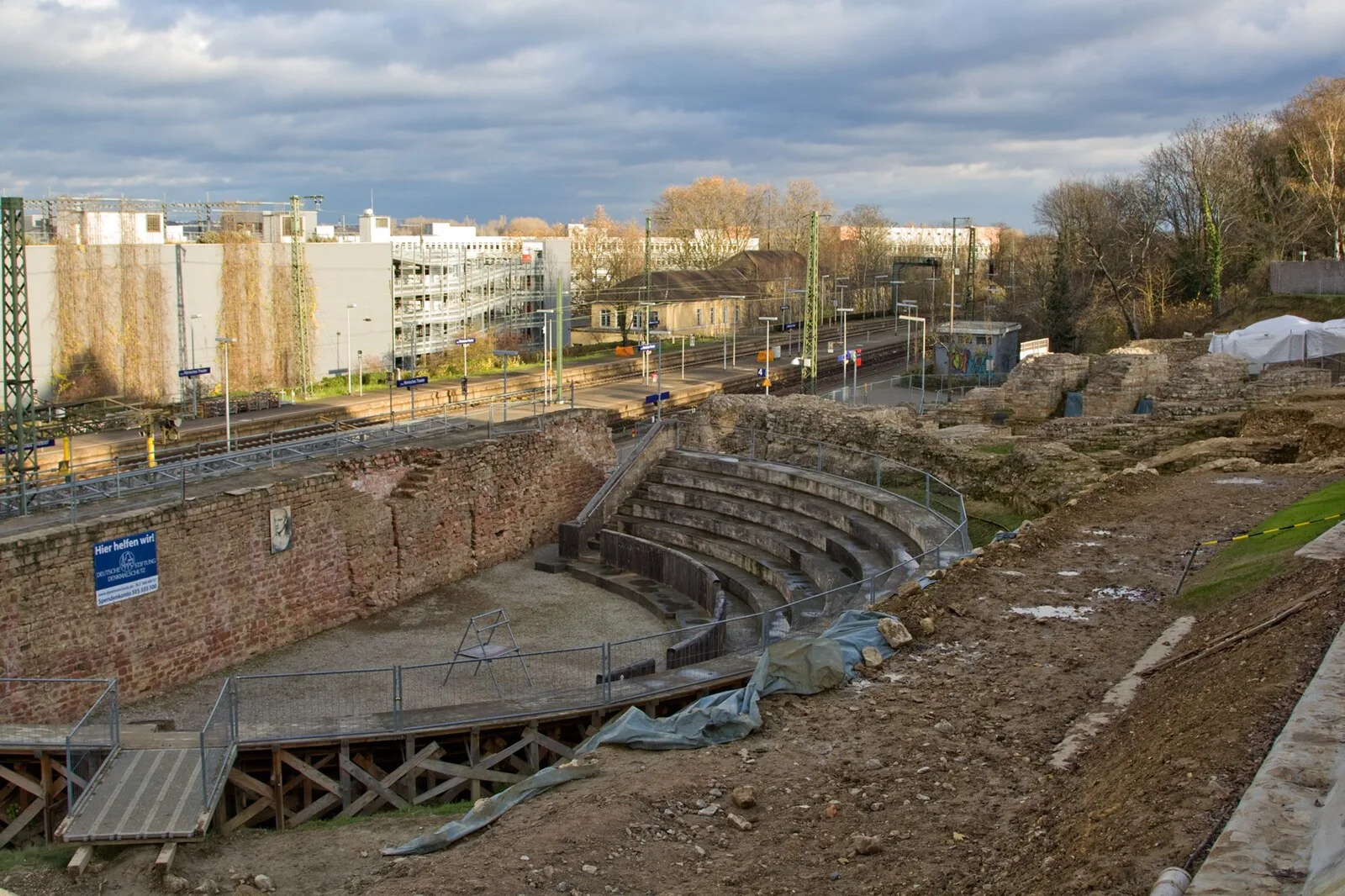
The Roman Theatre in Mainz, Rhineland Palatinate was excavated in the late 1990s [1]. It is located immediately next to the Mainz Römisches Theater station and was once the largest Roman theatre north of the Alps, with a diameter of 116 metres, a stage-width of 42 metres, and a capacity of roughly ten thousand people [1]. From 9 BC, military parades were held in honour of Drusus at his cenotaph, the Drususstein, which was only 340 metres away from the theatre [1]. Foundations of the stage building were found in 1884 during the construction of the railway and were recorded before being demolished to make way for the tracks and platforms of the South Station [1]. In 1914, when further remains were discovered during the construction of a canal, the art historian Ernst Neeb identified the remains as part of a Roman theatre building [1]. An exploratory excavation in 1916 supported his case, but because of the First World War, no further excavations could be undertaken [1]. In 1998, after several years of planning, several pillars were uncovered as part of a first test trench [1].
Text: Wikipedia – 'Roman Theatre (Mainz)' (revision of 2026-05-18), CC BY-SA 4.0 · sentences selected and shortened by an AI system · source →Roman Theatre, Mainz
Also known as: Roman theater at Mainz, Roman theater in Mainz, Roman theatre at Mainz, Roman Theatre (Mainz), Roma Tiyatrosu, Mainz, Romeins theater van Mainz, Römisches Theater Mainz, teatre romà de Magúncia, Teatro Romano de Mogoncíaco, Teatro Romano de Mogontiacum, Teatro romano di Magonza, théâtre antique de Mayence
| Type | Theatre |
|---|---|
| Period | 1 - 500 AD |
| Country | Germany |
| Coordinates | 49.9931° N, 8.2781° E |