
 Germany
The Wotanstein, also known as 'Wodanstein' or earlier on 'Malstein', is a small megalith or menhir situated close to the village of Maden, Schwalm-Eder-Kreis, Hesse, Germany [1]. The megalith is situated on the south-west corner of the village of Maden, on an elevation between the streams of the Goldbach to the east and Henkelborn to the west [1]. The land on which it stands has an elevation of 177 m [1]. The stone is c. 2.12 m high, 1.2 m wide, and 0.55 m thick [1]. The above-ground volume is thus 1.4 m3 and given quartzite has a density of 2,648 kg/m3, the above-ground stone weighs c. 3.7 metric tons [1]. In 1407 the stone was mentioned in documents as deme langen steyne zu Madin (English: the long stone at Madin (Maden)) [1]. According to oral tradition, during the Seven Years' War (1756–1763) it was excavated because it was rumoured that treasure was buried under it, but remains of human bones were found instead [1].
Text: Wikipedia – 'Wotanstein (Hesse)' (revision of 2026-07-19), CC BY-SA 4.0 · sentences selected and shortened by an AI system · source →Wotanstein, Hesse
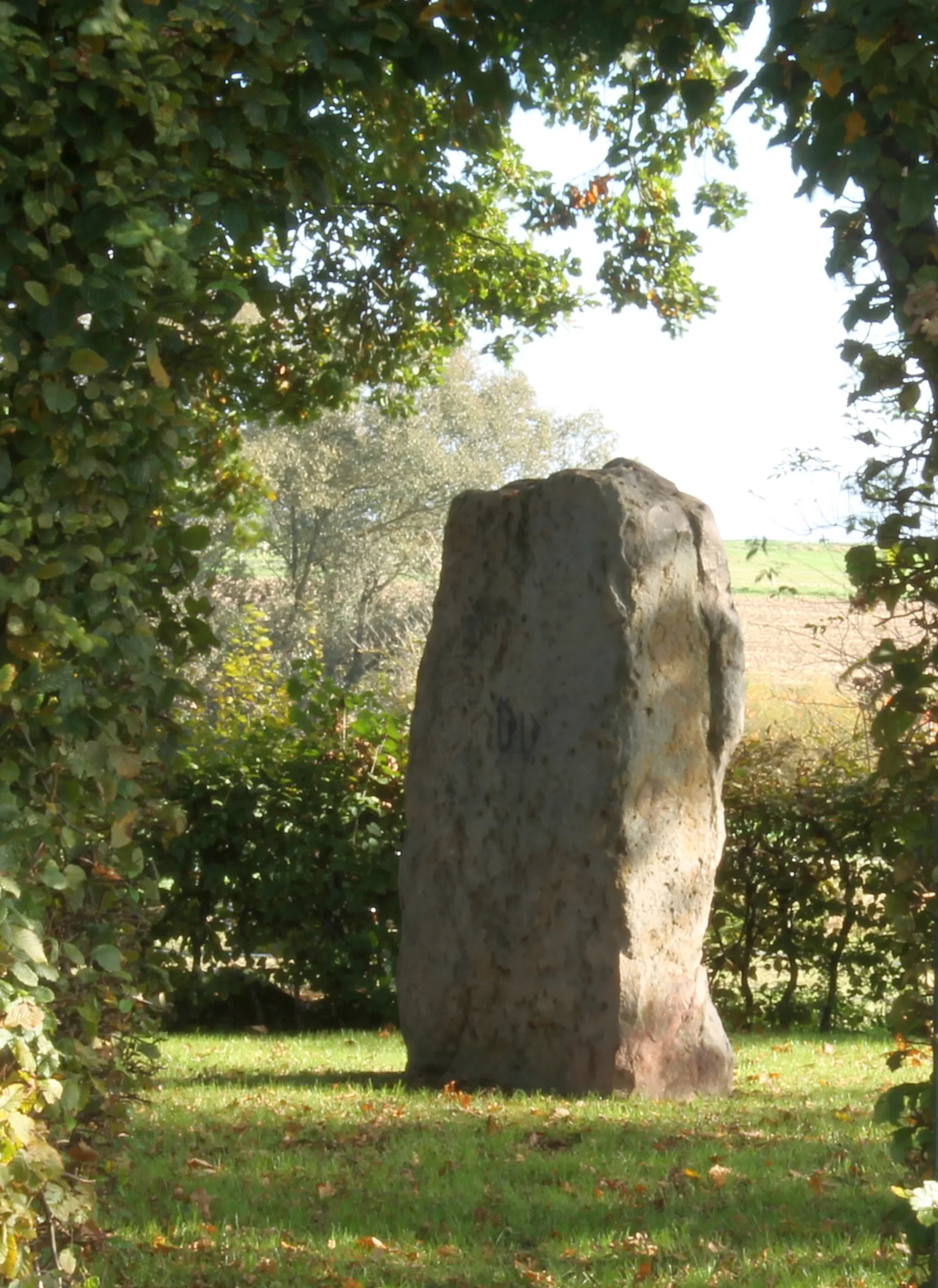
Also known as: Wodanstein in Maden, Wotanstein, Wotanstein (Hesse), Wotanstein in Maden, Вотанштајн
| Type | Megalithic stones |
|---|---|
| Period | 500 BC - 1 AD |
| Country | Germany |
| Coordinates | 51.1633° N, 9.3703° E |