
 Germany
The castellum or small fort nowadays called Am Forsthofweg was a Roman military camp of the Upper Germanic-Rhaetian Limes [1]. It received UNESCO World Heritage status in 2005 [1]. The fortification was located in the area of the current Bad Hönningen association of municipalities within the district of Neuwied in Rhineland-Palatinate, Germany [1]. The fort was discovered in 1894 under the direction of Heinrich Jacobi, the local section commissioner of the Imperial Limes Commission, and examined in two excavation campaigns in 1894 and 1901 [1]. The Roman fortlet "Am Forsthofweg" is an almost square earthwork [1]. A rampart and a ditch 5 meters wide and 1.5 meters deep served as a first defense line [1]. With its only gate, the camp faced north, towards the Limes frontline [1]. A wooden construction of unknown function, covering around 45 square meters was found inside [1].
Text: Wikipedia – 'Am Forsthofweg' (revision of 2024-12-24), CC BY-SA 4.0 · sentences selected and shortened by an AI system · source →Am Forsthofweg
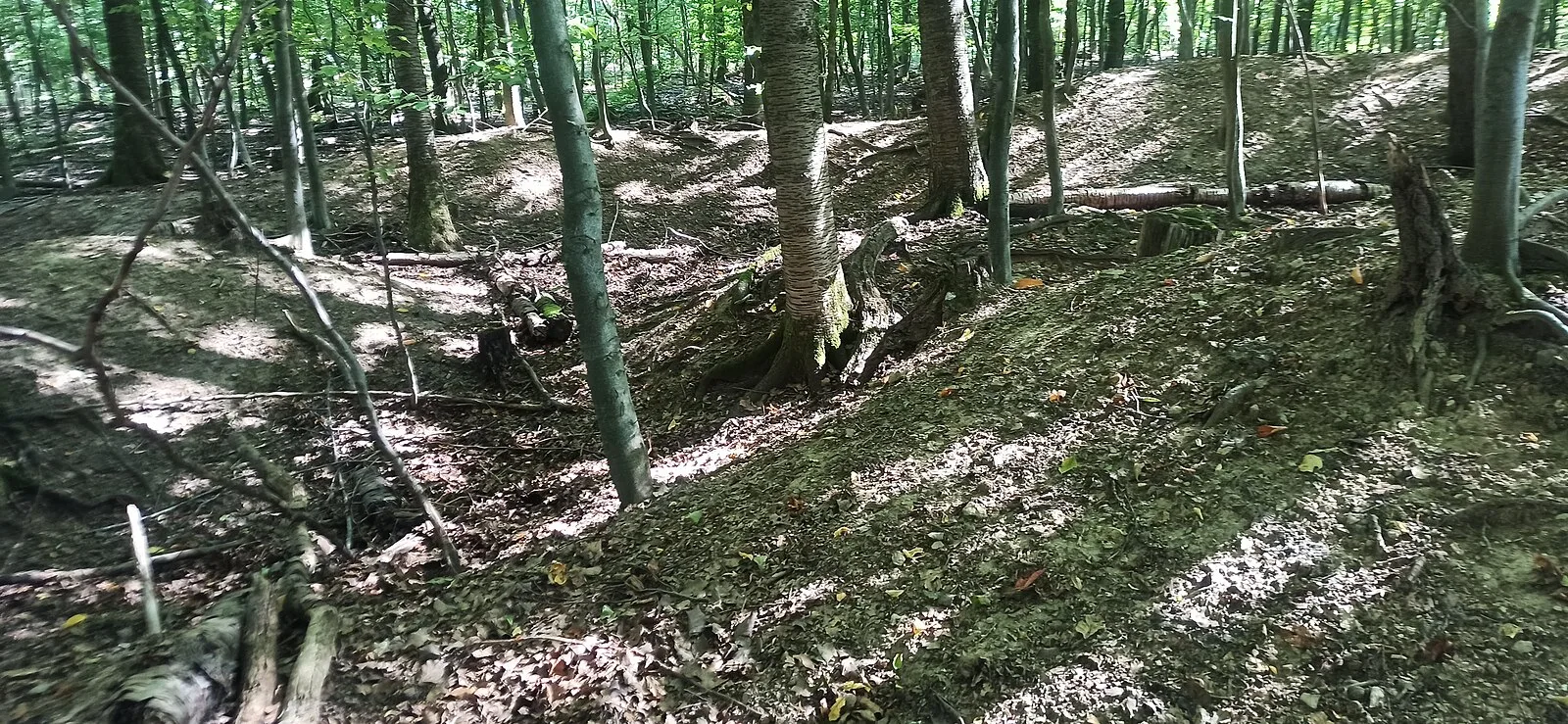
Also known as: Castellum on Forsthofweg, Kastell Am Forsthofweg, Kleinkastell „Am Forsthofweg“, Kleinkastell Am Forsthofweg, Limeskastell Am Forsthofweg, Römerkastell Am Forsthofweg, Römerlager Am Forsthofweg
| Type | Fortress/citadel |
|---|---|
| Period | 1500 - 500 BC |
| Country | Germany |
| Coordinates | 50.4942° N, 7.3938° E |