
 England
Ambleside Roman Fort is the modern name given to the remains of a fort of the Roman province of Britannia [1]. Dating to the 1st or 2nd century AD, its ruins are located on the northern shore of Windermere at Waterhead, near Ambleside, in the English county of Cumbria [1]. The earliest, smaller, version of the fort was probably founded around the time of Agricola (AD 80–5), and it was occupied until at least AD 365 [1]. The remains of the fort were excavated in the second decade of the 20th century by historian R. G. Collingwood [1]. The fort consisted of a rectangular enclosure measuring approximately 91 by 128 metres, and covering an area of almost 1.2 hectares [1]. The fort had towers at each corner, and was enclosed by a 1.2-metre thick wall of roughly coursed stone [1]. A tombstone found at Ambleside bore an inscription that translates as "killed within the fort by the enemy", indicating that at some point the fort was attacked, but that Roman control of the area continued [1]. Finds from the early 20th century excavations included some coins of Faustina Iunior, Iulia Domna, and Valens [1].
Text: Wikipedia – 'Ambleside Roman Fort' (revision of 2026-08-21), CC BY-SA 4.0 · sentences selected and shortened by an AI system · source →Ambleside Roman Fort
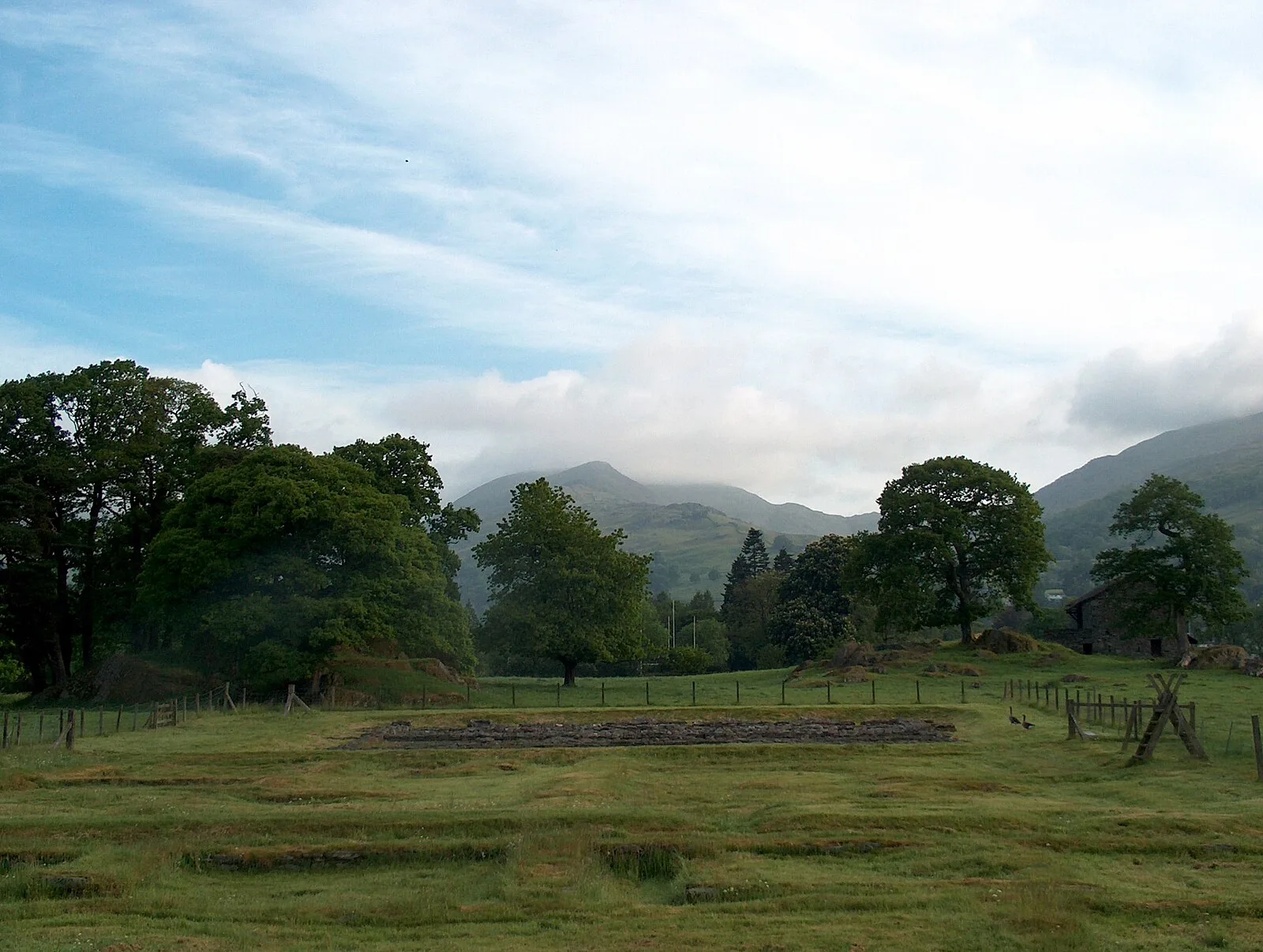
Also known as: Ambleside (římská pevnost), Ambleside Roman fort, associated vicus and Roman road, Camp romain d'Ambleside, Forte Romano Ambleside, Forte romano de Ambleside, Fort romain d'Ambleside, Galava, nirvana, 奄堡西羅馬兵營
| Type | Fortress/citadel |
|---|---|
| Period | 1 - 500 AD |
| Country | England |
| Coordinates | 54.4224° N, 2.9687° W |