
 England
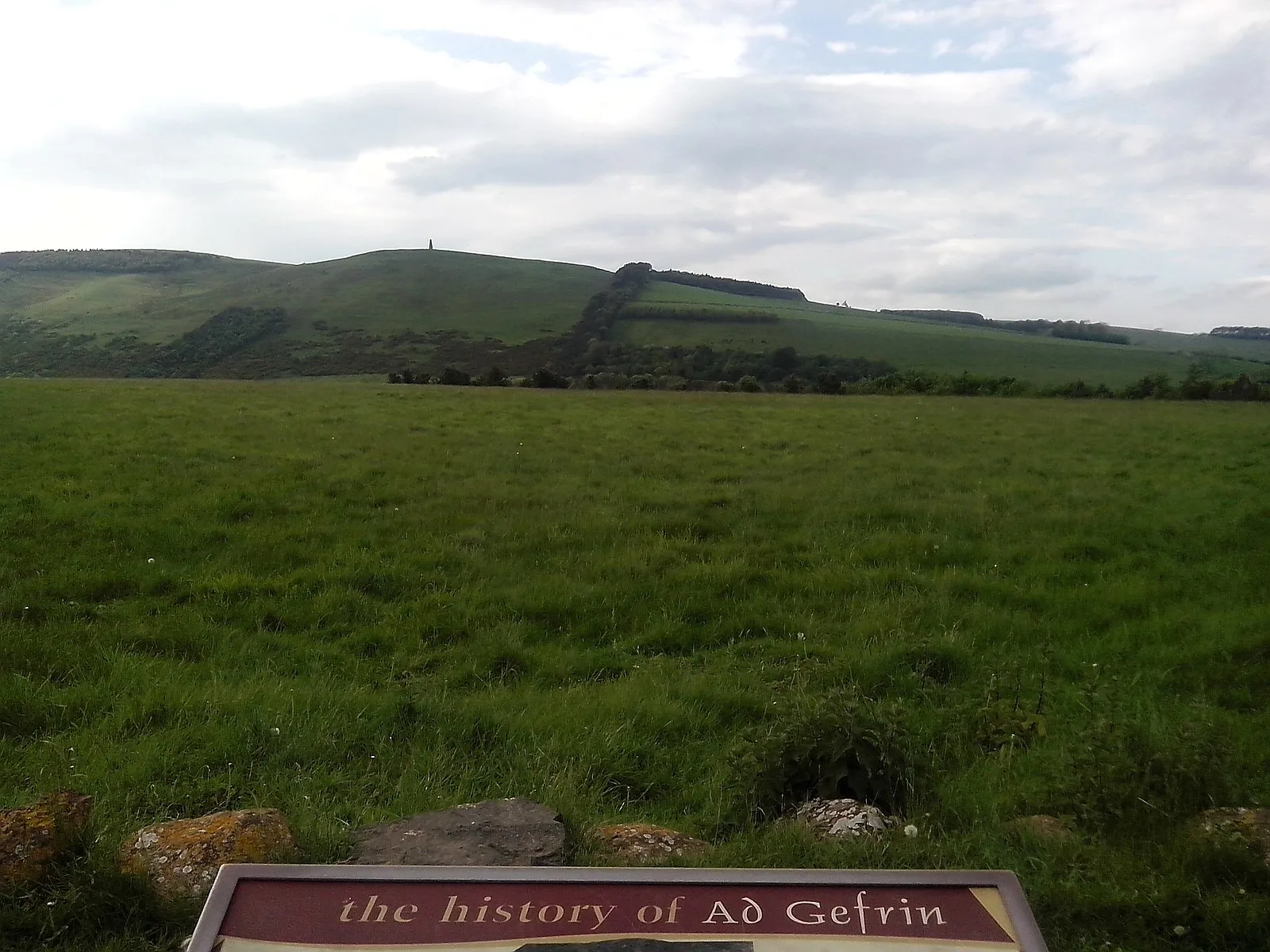
Evidence for human activity in the vicinity has been found from the Mesolithic, Neolithic and Bronze Age periods, although the first significant settlement at Yeavering occurred in the Iron Age [1]. In this period, a heavily inhabited hillfort was constructed on Yeavering Bell which appears to have been a major settlement centre at the time [1]. According to Book 2 Chapter 14 of the Ecclesiastical History of the Venerable Bede, in the year 627 Bishop Paulinus of York accompanied the Northumbrian king Edwin and his queen Æthelburg to their royal vill, Adgefrin [1]. The name of Yeavering is first attested in Bede's Ecclesiastical History of the English People of 731, where it has the form ad gefrin [1]. To the north of the Bell, the land drops off to a terrace 72 metres above sea level, which is where the Anglo-Saxon settlement was located [1]. In the early medieval period, the area was home to Gefrin (Yeavering), a Royal settlement in the Anglo-Saxon ruled kingdom of Bernicia [1].
Text: Wikipedia – 'Yeavering' (revision of 2026-08-03), CC BY-SA 4.0 · sentences selected and shortened by an AI system · source →Yeavering
Also known as: Yeavering, Northumberland, Yevering, یہورنگ, 耶弗林
| Type | City/town/settlement |
|---|---|
| Period | 500 - 1000 AD |
| Country | England |
| Coordinates | 55.5662° N, 2.1022° W |