
 England
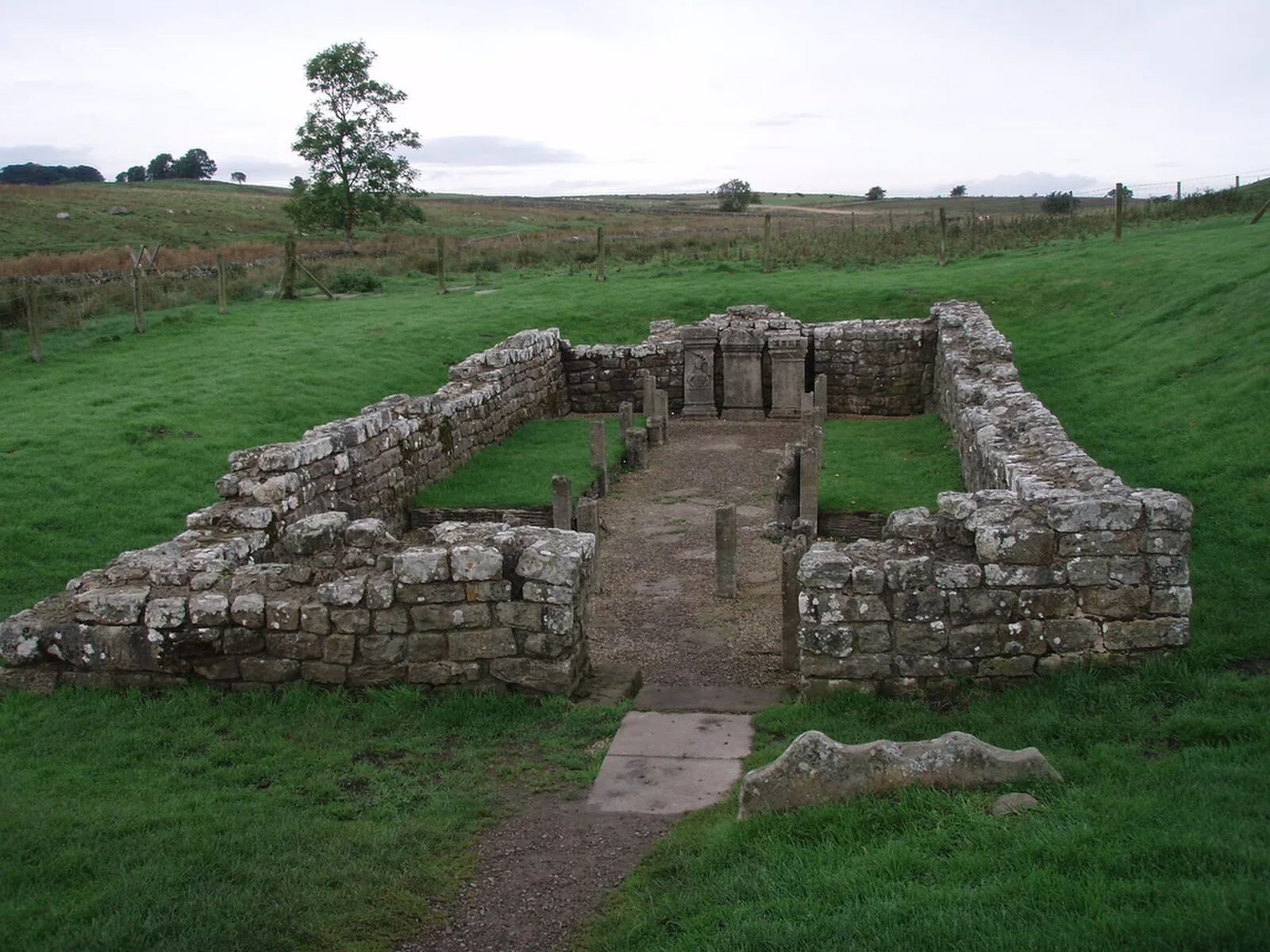
Carrawburgh is a settlement in Northumberland [1]. In Roman times, it was the site of a 3+1⁄2-acre auxiliary fort on Hadrian's Wall called Brocolitia, Procolita, or Brocolita [1]. Hadrian's Wall was built from 122 AD and most of the wall forts a few years later [1]. Brocolitia was built a few years later still probably to fill a slightly longer gap between forts at Housesteads, 5.2 miles away, and Chesters, 3.5 miles away [1]. A date of 130 has been suggested from a fragmentary inscription now in the Chesters Museum [1]. The vicus (civilian settlement) was just outside the west side of the fort and covered about 4 hectares [1]. The remains of three Roman sanctuaries have been discovered in the low-lying marshy ground beyond the fort's south-west corner [1]. Nearest to the fort, about 80 metres from its south-west corner, are the remains of an early 3rd century mithraeum, i.e. a temple of the mystery cult of the Roman god Mithras [1].
Text: Wikipedia – 'Carrawburgh' (revision of 2026-08-21), CC BY-SA 4.0 · sentences selected and shortened by an AI system · source →Carrawburgh
Also known as: Brocolitia, Brocolitia Roman fort, Carrawburgh, Northumberland, Fort romain de Carrawburgh, Fort van Carrawburgh, کیرا برگ, 卡洛堡, 卡羅伯格
| Type | Fort |
|---|---|
| Period | 1 - 500 AD |
| Country | England |
| Coordinates | 55.0363° N, 2.2231° W |