
 England
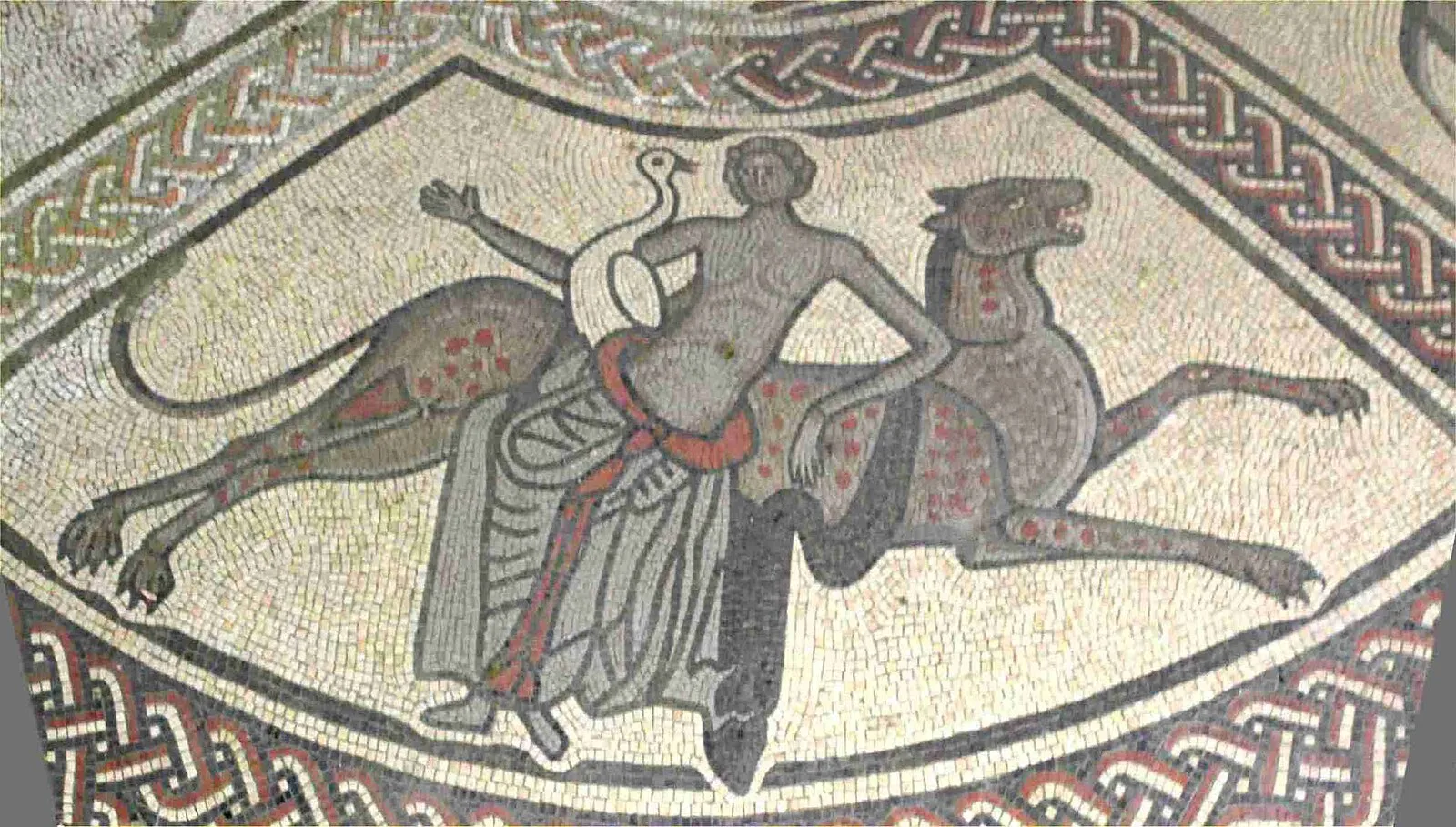
Littlecote Roman Villa is an extensive and exceptional Roman villa, with associated religious complex, at Littlecote Park just over a mile west of Hungerford, Berkshire [1]. In 1727–1728 William George discovered the Orpheus mosaic whilst digging post-holes [1]. At its height, the villa had around sixty rooms, two thermal bath suites, many mosaic floors and several heated hypocausts [1]. The large courtyard villa enclosed an area of about 1 ha, making it one of the largest in Britain [1]. The separate building with the triconch-form mosaics attached to a large courtyard building is interpreted as a religious cult centre, associated with the pagan revival under Julian the Apostate (361–363) [1]. The settlement began life as a small short-lived military establishment guarding a road crossing of the River Kennet [1]. From 70 AD the road was still used and the site passed to local ownership with circular huts and in 120 a Roman-style rectangular timber building replaced them [1]. In 170 this was replaced by a large two-storeyed winged stone corridor villa with integral bath suite [1].
Text: Wikipedia – 'Littlecote Roman Villa' (revision of 2026-03-23), CC BY-SA 4.0 · sentences selected and shortened by an AI system · source →Littlecote Roman Villa
Also known as: Littlecote villa, Roman villa of Littlecote, Vila romana de Littlecote, villa romaine de Littlecote, Villa romana di Littlecote, Villa Rustica (Littlecote), Villa Rustica Littlecote, Villa rustica of Littlecote, 利特爾科特別墅
| Type | Residence/villa/farmhouse |
|---|---|
| Period | 1 - 500 AD |
| Country | England |
| Coordinates | 51.4334° N, 1.5697° W |