
 England
Liddington Castle, locally called Liddington Camp, is a late Bronze Age and early Iron Age univallate hillfort in Liddington parish in the English county of Wiltshire [1]. The site is on a commanding high point close to the Ridgeway and covers an area of 3 hectares [1]. Liddington Castle was one of the earliest hillforts in Britain, with first occupation dating to the 7th century BC [1]. The earthworks consist of a relatively simple oval bank of timber and earth fronted by a ditch, with opposing causewayed entrances on the east and west sides [1]. During a later phase the bank and ditch were improved and a rampart of dumped chalk increased the height of the bank [1]. The hillfort was partially excavated in 1976 [1]. The excavation revealed a large pit 1.5 metres in diameter and at least 2.4 metres deep [1]. The bottom of the feature was not reached and it was interpreted by the archaeologists who dug it as a ritual shaft [1].
Text: Wikipedia – 'Liddington Castle' (revision of 2026-08-08), CC BY-SA 4.0 · sentences selected and shortened by an AI system · source →Liddington Castle
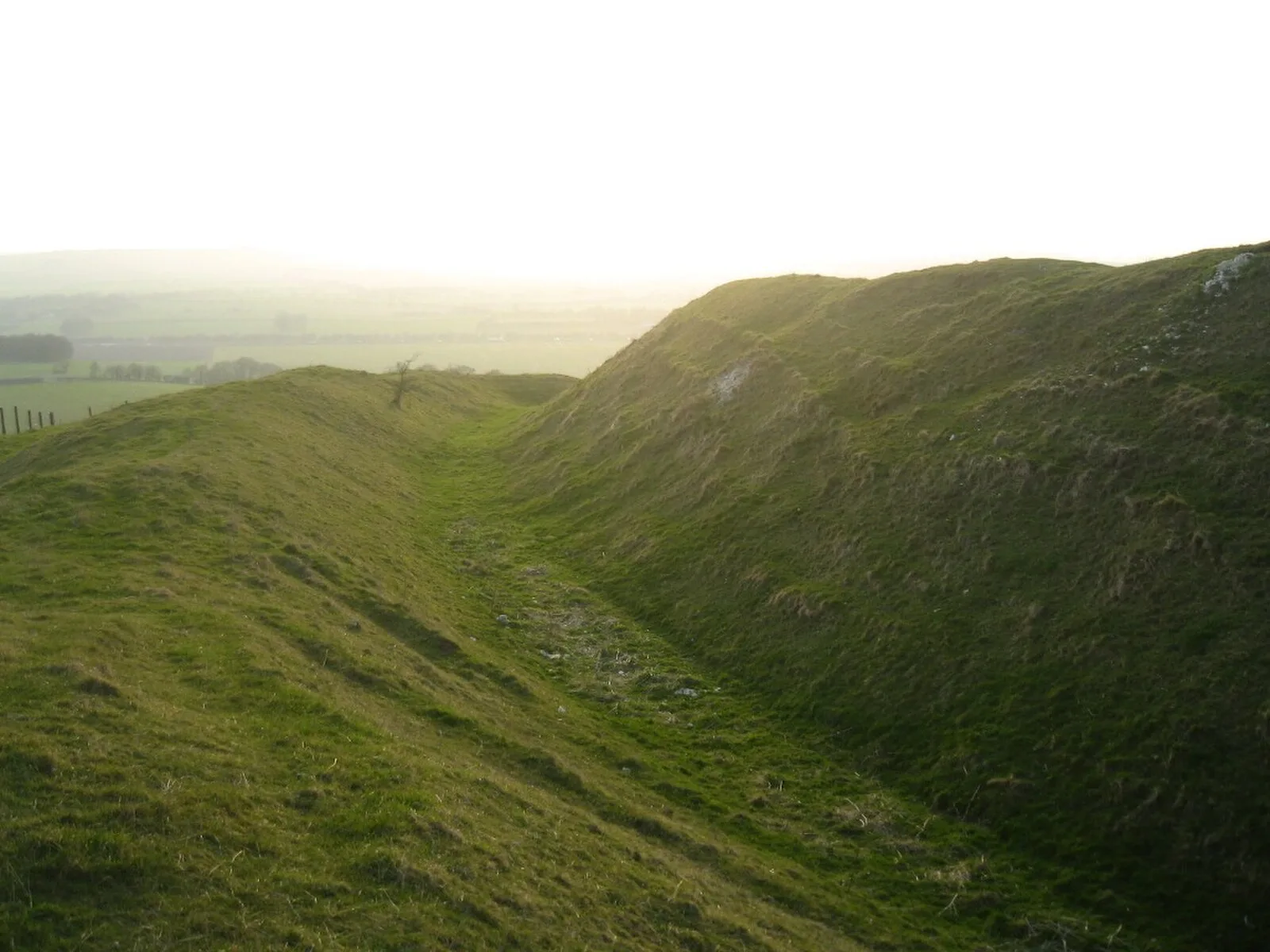
Also known as: Badbury Camp, Liddington Camp, Liddington Kalesi
| Type | Fortress/citadel |
|---|---|
| Period | 1500 - 500 BC |
| Country | England |
| Coordinates | 51.5161° N, 1.7000° W |