
 Egypt
EgyptThe pyramid of Senusret I is an Egyptian pyramid built to be the burial place of the Pharaoh Senusret I. The pyramid was built during the Twelfth Dynasty of Egypt at el-Lisht, near the pyramid of his father, Amenemhat I. Its ancient name was Senusret Peter Tawi [1]. The pyramid was 105 meters on each side with a height of 61.25 meters; the slope of the four faces was 49° 24' [1]. The pyramid used a method of construction never before seen in an Egyptian pyramid; four stone walls radiated from the center built of rough-hewn blocks that decreased in size the higher their placement [1]. Surrounding the actual structure was a comparatively large complex, which consisted of a mortuary temple, a rectangular structure with a courtyard in the center, and nine smaller pyramids for Senusret's queens [1]. The pyramid was first explored by archaeologists Gautier and Jequier between 1894 and 1895 [1]. Many statues of Senusret I were found and are now at the Egyptian Museum in Cairo [1].
Text: Wikipedia – 'Pyramid of Senusret I' (revision of 2026-06-28), CC BY-SA 4.0 · sentences selected and shortened by an AI system · source →Pyramid of Senusret I
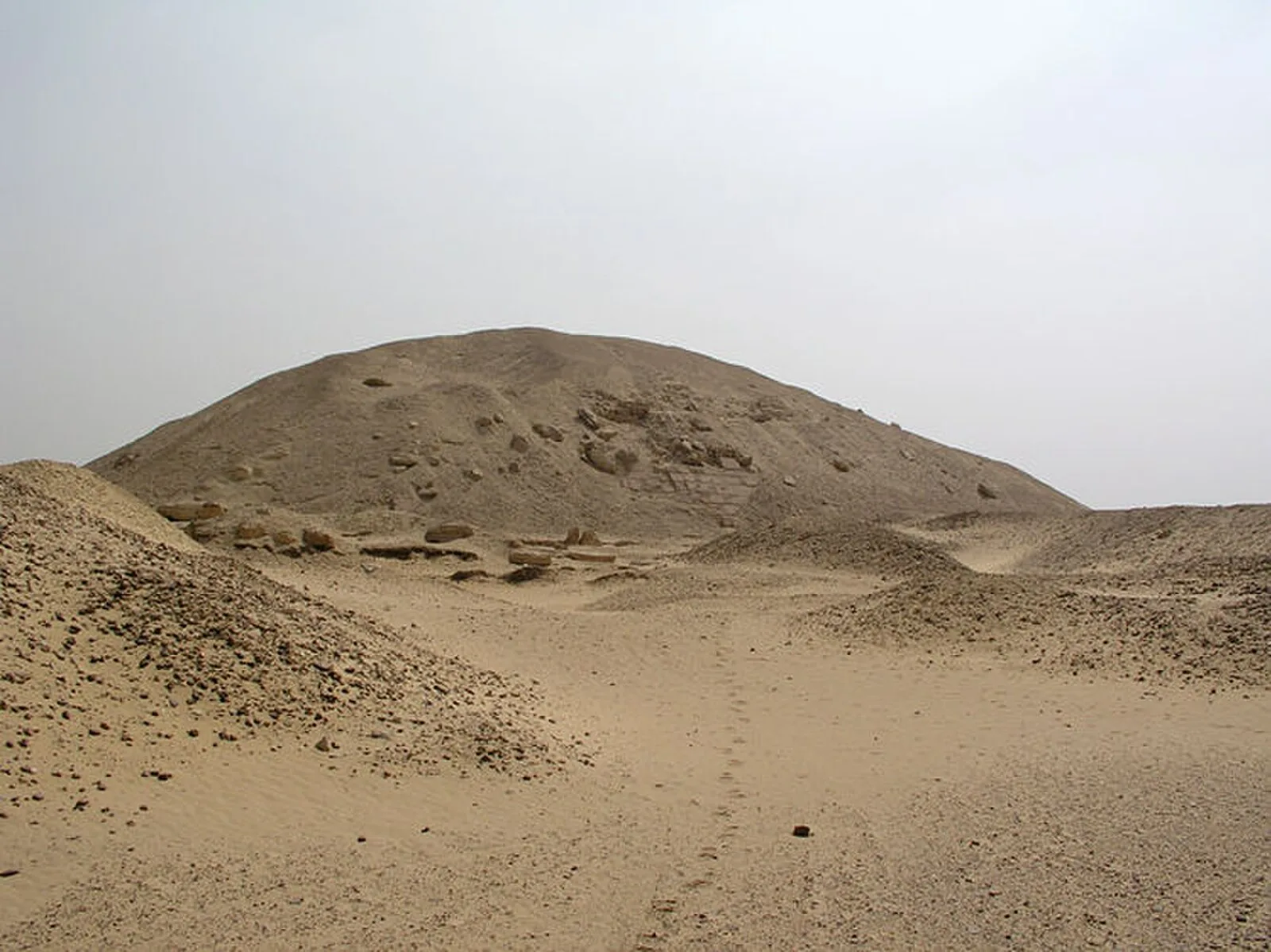
Also known as: Kim tự tháp Senusret I, Piramida Senusereta I, piràmide de Senusret I, piramide di Sesostri I, Piramide van Senoeseret I, Pyramída Senusreta I., pyramide de Sésostris Ier, Senusret 1 Piramidi, Sesostris-I.-Pyramide, Πυραμίδα του Σέσωστρη, Πυραμίδα του Σέσωστρι Α΄, Пирамида Сенусерта I
| Type | Pyramid complex |
|---|---|
| Period | 3000 - 1500 BC |
| Country | Egypt |
| Coordinates | 29.5636° N, 31.2216° E |