
 Lebanon
Baalbek was called Heliopolis during the Roman Empire, a latinisation of the Greek Hēlioúpolis used during the Hellenistic period, meaning "Sun City" in reference to the solar cult there [1]. After Alexander the Great's conquest of Persia in the 330s BC, Baalbek formed part of the Diadochi kingdoms of Egypt & Syria [1]. "Baalbek, with its colossal structures, is one of the finest examples of Imperial Roman architecture at its apogee", UNESCO reported in making Baalbek a World Heritage Site in 1984 [1]. Recent cleaning operations at the Temple of Jupiter discovered the deep trench at its edge, whose study pushed back the date of Tell Baalbek's settlement to the PPNB Neolithic [1]. The Tell Baalbek temple complex, fortified as the town's citadel during the Middle Ages, was constructed from local stone, mostly white granite and a rough white marble [1].
Text: Wikipedia – 'Baalbek' (revision of 2026-09-15), CC BY-SA 4.0 · sentences selected and shortened by an AI system · source →Baalbek
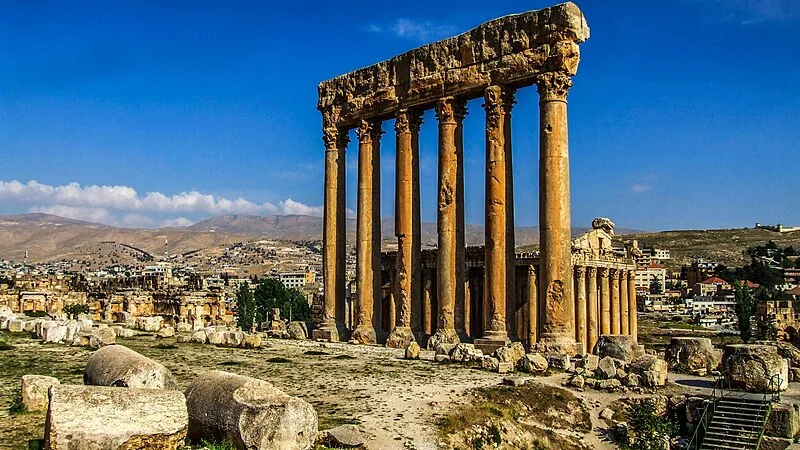
Also known as: 바알벡, 바알베크, Ba'albak, Baalbec, Baalbeck, Baalbeka, Baalbekas, Baalbek-Deir El-Ahmar, Baalbek (kapital sa lalawigan sa Lebanon), Ba'labakk, Balabakk, Balabbak
| Type | Temple complex |
|---|---|
| Period | < 4500 BC |
| Country | Lebanon |
| Coordinates | 34.0075° N, 36.2061° E |