
 Lebanon
The Temple of Bacchus is part of the Baalbek archaeological site, in Beqaa Valley region of Lebanon [1]. The temple complex is considered an outstanding archaeological and artistic site of Imperial Roman Architecture and was inscribed as a UNESCO World Heritage Site in 1984 [1]. It is one of the best preserved and grandest Roman temple ruins; its age is unknown, but its fine ornamentation can be dated to the second century CE [1]. The temple was probably commissioned by Roman Emperor Antoninus Pius [1]. The temple continued in use until destroyed by fire in 554 [1]. The Temple of Bacchus was possibly protected by the rubble of the rest of the site's ruins [1]. It was not until 1898–1903 that a German expedition excavated two of the large temples and began reconstructions on the site [1]. The temple is 66 m long, 35 m wide and 31 m high, making it only slightly smaller than the Temple of Jupiter [1].
Text: Wikipedia – 'Temple of Bacchus' (revision of 2026-09-15), CC BY-SA 4.0 · sentences selected and shortened by an AI system · source →Temple of Bacchus
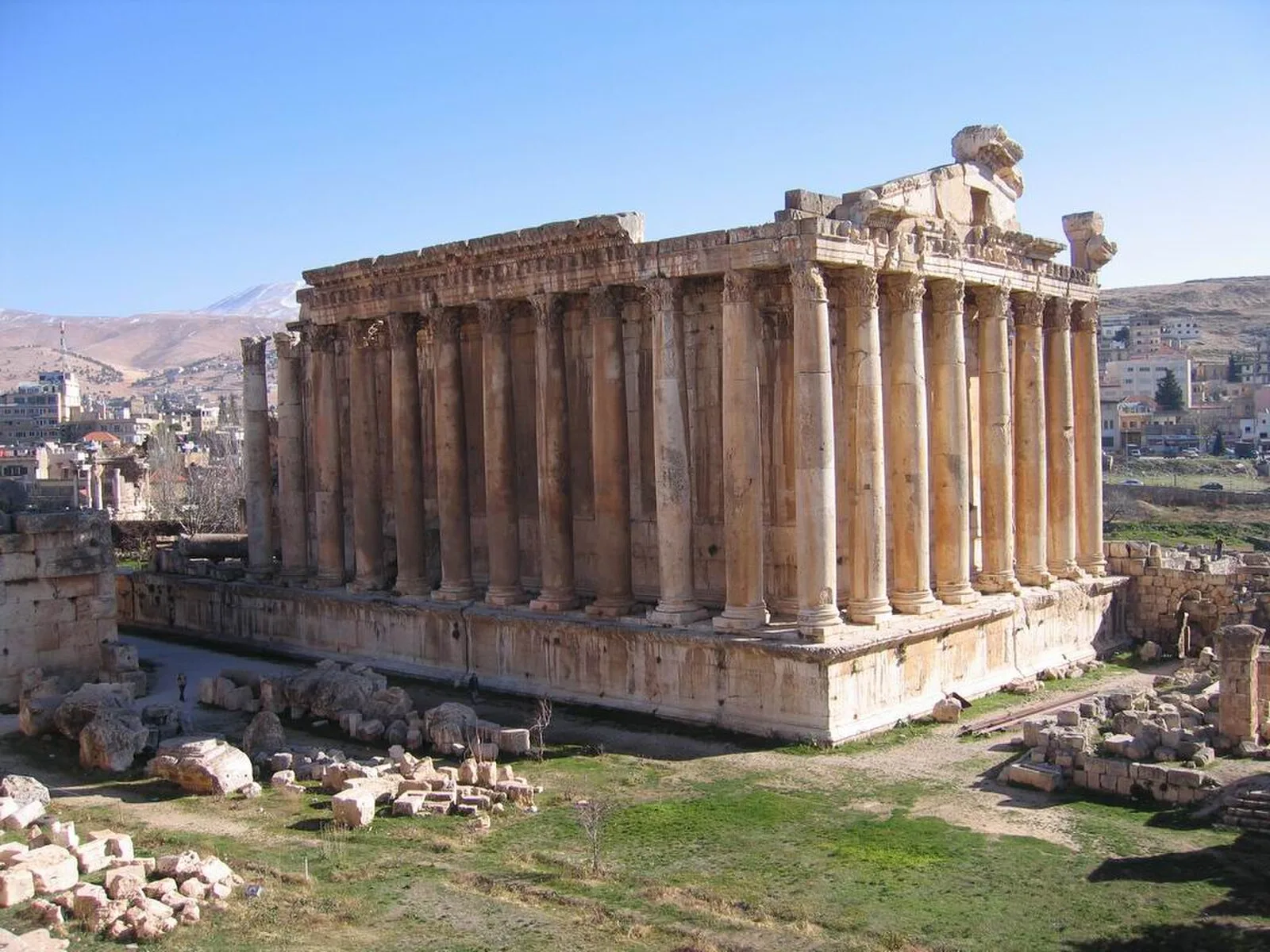
Also known as: 바쿠스 신전, Bakchův chrám, Bakhov tempelj v Baalbeku, Świątynia Bachusa, Świątynia Bachusa w Baalbeku, Tempel van Bacchus, temple de Bacchus, temple de Bacus, Templo de Baco, Ναός του Βάκχου στο Μπάαλμπεκ, מקדש בכחוס, מקדש בכחוס (בעלבכ)
| Type | Temple |
|---|---|
| Period | 1 - 500 AD |
| Country | Lebanon |
| Coordinates | 34.0062° N, 36.2039° E |