
 France
The Amphitheatre of the Three Gauls of Lugdunum (Lyon) was part of the Sanctuary of the Three Gauls dedicated to the cult of Rome and Augustus celebrated by the 60 Gallic tribes when they gathered at Lugdunum [1]. The amphitheatre was built at the foot of the La Croix-Rousse hill at what was then the confluence of the Rhône and Saône [1]. An inscription on one of the blocks found in 1957 connects the amphitheatre with the sanctuary of Rome and Augustus and allows its origins to be identified [1]. The amphitheatre was expanded at the start of the 2nd century, according to J. Guey by C. Julius Celse [1]. The first excavations between 1818 and 1820 revealed the perimeter of the arena before re-covering it [1]. From 1956 serious excavations were begun, followed by 1966/67, 1971/72 and 1976/78 campaigns [1].
Text: Wikipedia – 'Amphitheatre of the Three Gauls' (revision of 2026-05-18), CC BY-SA 4.0 · sentences selected and shortened by an AI system · source →Amphitheatre of the Three Gauls
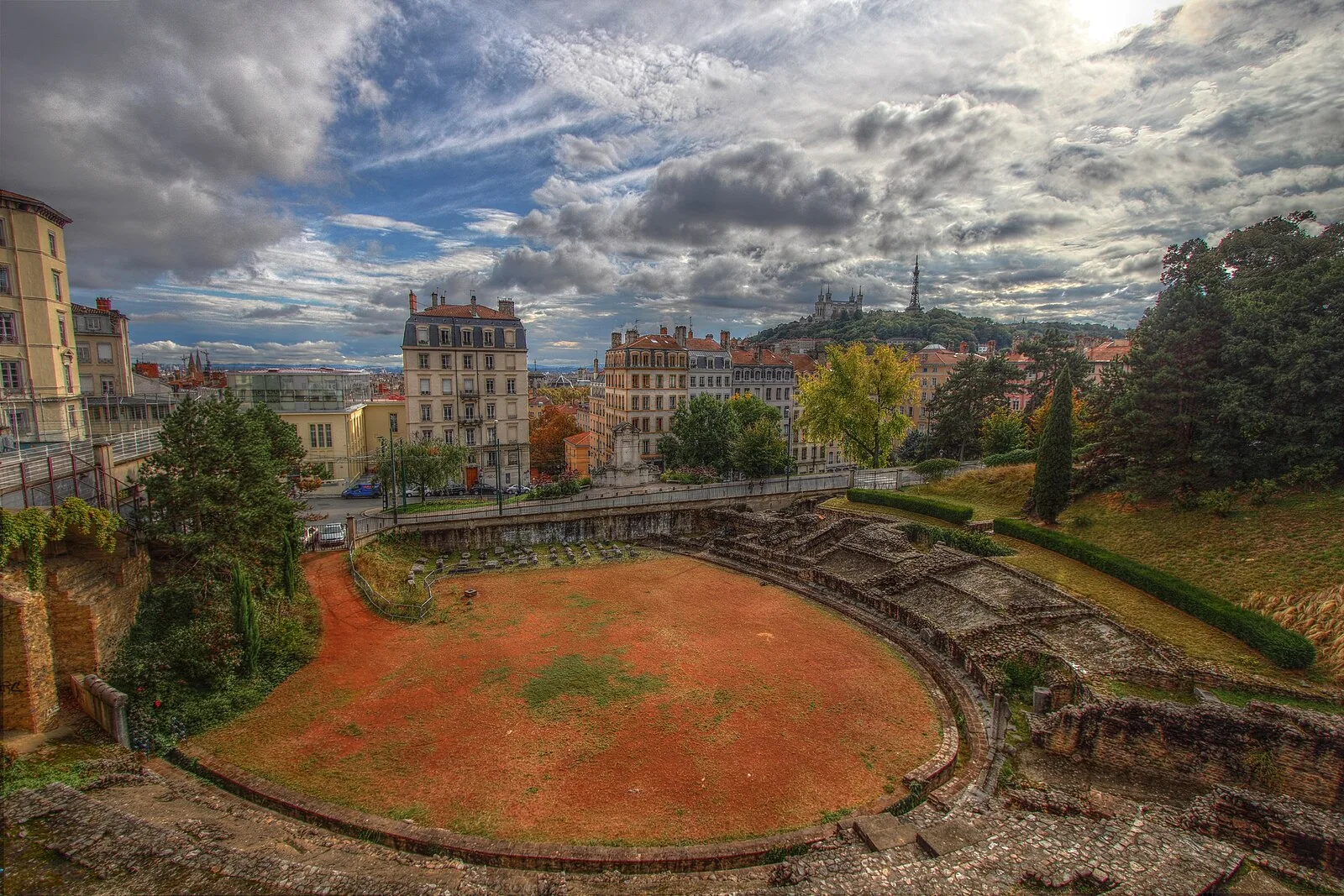
Also known as: amfiteater treh Galcev, Amfiteater treh Galij, amfiteater v Lyonu, amfiteatre de les Tres Gàl·lies, Amfitheater van de drie Gallien, Amphithéâatre de la Croix-Rousse, Amphitheater der drei Gallien, amphitheater of Lyon, Amphitheater von Lyon, amphithéâtre de Lugdunum, amphithéâtre de Lyon, amphithéâtre des Trois Gaules
| Type | Amphitheatre |
|---|---|
| Period | 1 - 500 AD |
| Country | France |
| Coordinates | 45.7707° N, 4.8306° E |