
 France
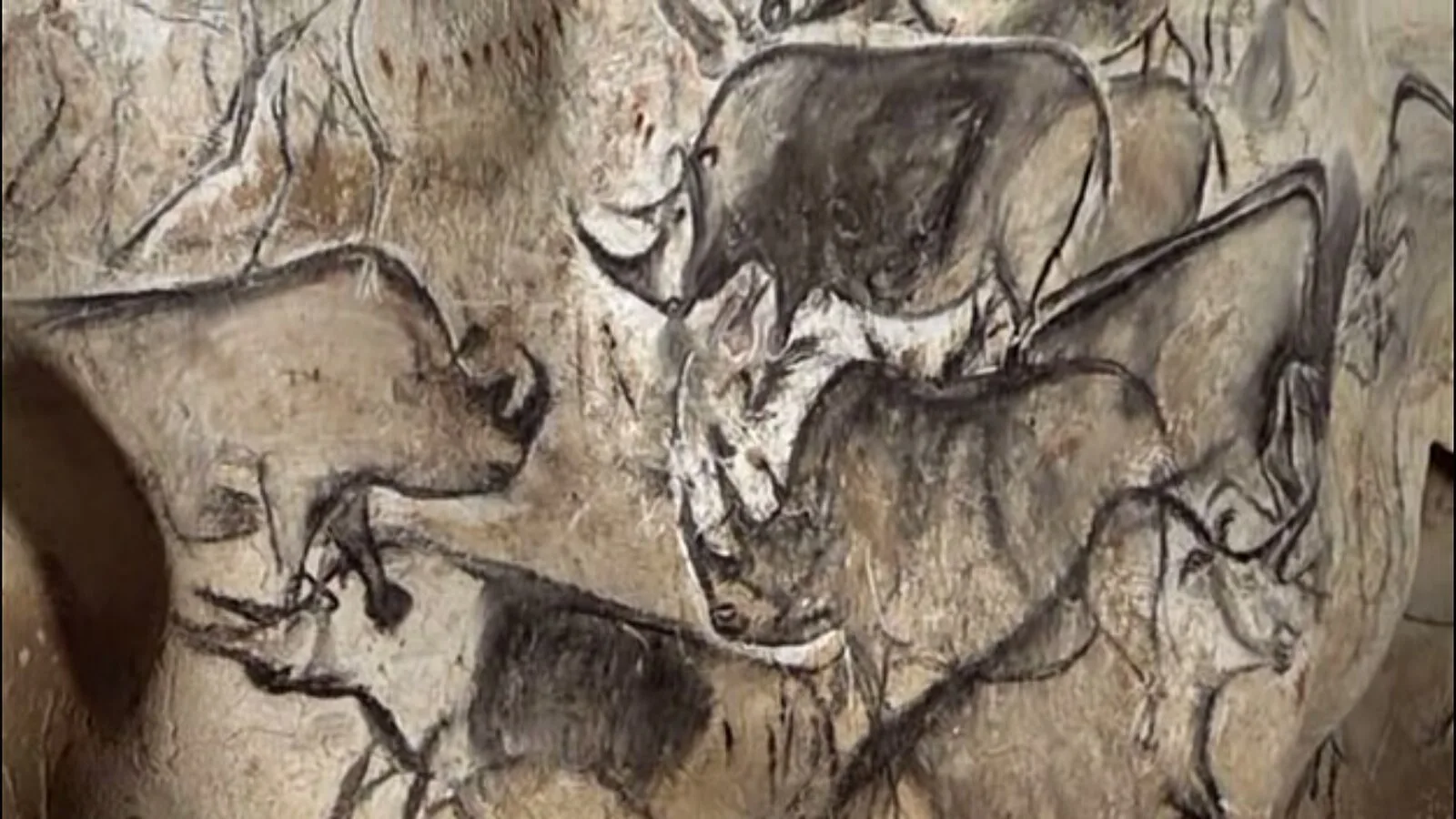
Rather than depicting only the familiar herbivores that predominate in Paleolithic cave art, i.e. horses, aurochs, mammoths, etc., the walls of the Chauvet Cave feature many predatory animals, e.g., cave lions, leopards, bears, and cave hyenas [1]. There are also paintings of rhinoceroses [1]. Typical of most cave art, there are no paintings of complete human figures, although there are two partial "Venus" figures: one within a niche or vestibule of the End Chamber, and the other on a roughly conical or dental-shaped pendant several metres away; both are composed of what appears to be a vulva attached to an incomplete pair of legs [1]. Above the pendant Venus, and in contact with it, is a bison head, which has led some to describe the composite drawing as a Minotaur [1]. There are a few panels of red ochre hand prints and hand stencils made by blowing pigment over hands pressed against the cave surface [1].
Text: Wikipedia – 'Chauvet Cave' (revision of 2026-09-13), CC BY-SA 4.0 · sentences selected and shortened by an AI system · source →Chauvet Cave
Also known as: 쇼베 동굴, Bauma de Chauvet, Caverna de Chauvet, Chauvet, Chauvet-barlang, Chauvetgrottan, Chauvetgrotten, Chauvet-Hiel, Chauvethöhle, Chauvet-Höhle, Chauvet leizea, Chauvet Mağarası
| Type | Cave Structures |
|---|---|
| Period | < 4500 BC |
| Country | France |
| Coordinates | 44.3876° N, 4.4142° E |