
 France
The Roman Theatre of Orange is a Roman theatre in Orange, Vaucluse, France [1]. It was built early in the 1st century AD [1]. The Orange theatre was created under the rule of Augustus, and is believed to be one of the first of its kind in this area of modern-day France [1]. One of the most iconic parts of this structure is the grand exterior facade, which measures 103 meters long and 37 meters high [1]. Originally, there was a wooden roof across the theatre to protect the audience from unfavorable weather conditions [1]. There is evidence on the walls that shows that, at some point, the roof was destroyed in a fire [1]. As the Western Roman Empire declined during the 4th century, by which time Christianity had become the official religion, the theatre was closed by official edict in AD 391 [1]. Reconstruction began in 1825 with the intent of returning the theatre to its original purpose: to host large, exciting performances [1].
Text: Wikipedia – 'Roman Theatre of Orange' (revision of 2026-07-24), CC BY-SA 4.0 · sentences selected and shortened by an AI system · source →Roman Theatre of Orange
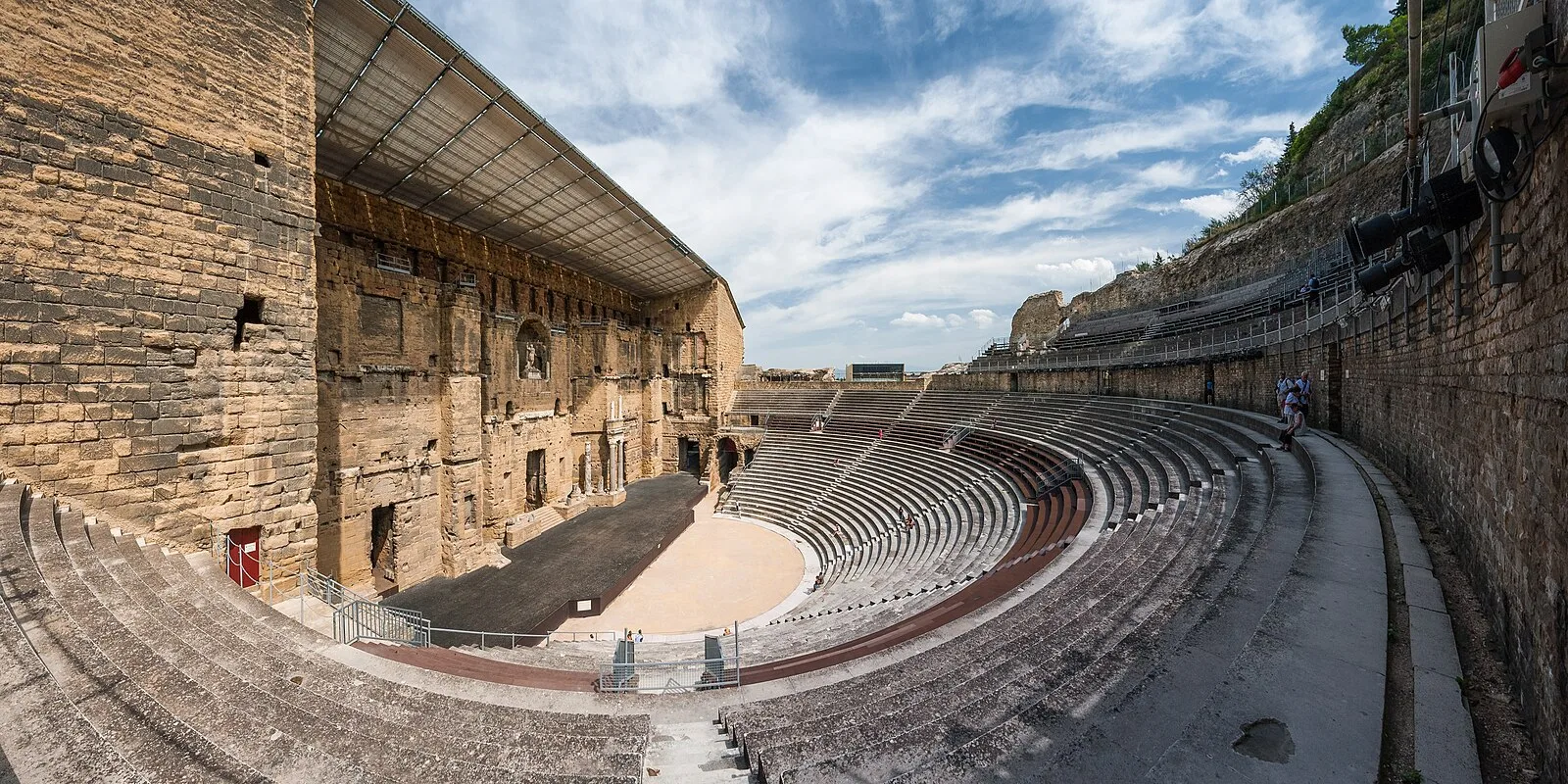
Also known as: 오랑주 고대극장, Det romerske teateret i Orange, Det romerske teater i Orange, Det romerske teater (Orange), Nhà hát cổ ở Orange, Orangeko erromatar antzokia, Orangen roomalainen teatteri, Oranžo romėnų teatras, Rímske divadlo, Římské divadlo v Orange, Rimski spomenici u Orangeu, Rimsko gledališče, Orange
| Type | Theatre |
|---|---|
| Period | 1 - 500 AD |
| Country | France |
| Coordinates | 44.1359° N, 4.8084° E |