
 England
Cholesbury Camp is a large and well-preserved Iron Age hill fort on the northern edge of the village of Cholesbury in Buckinghamshire [1]. It is roughly oval-shaped and covers an area, including ramparts, of 15 acres, and measures approximately 310 m north-east to south-west by 230 m north-west to south-east [1]. The fort is of the multivallate type [1]. Excavations by Day Kimball in 1932 indicated that during the Iron Age, Cholesbury Camp was only sparsely, and possibly intermittently inhabited, presumably in times of strife when it provided a refuge or a defensive position [1]. Well-preserved remains of prehistoric hearths or fire-sites and the remains of a clay-lined oven were found [1]. Three of the hearths appear to have been used to smelt iron, also evidenced by finds of bloomery slag [1]. Only a few poor quality pottery shards were found from the Middle Iron Age period, in contrast to numerous fragments of Belgic pottery from the Late Iron Age (approximately 200BC-50AD) [1]. The main period of occupation appears to have been around the middle of the 1st century BC [1].
Text: Wikipedia – 'Cholesbury Camp' (revision of 2026-03-10), CC BY-SA 4.0 · sentences selected and shortened by an AI system · source →Cholesbury Camp
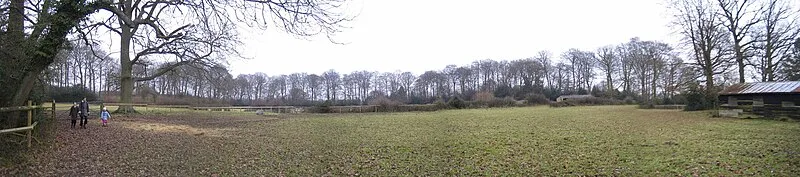
Also known as: Bury Hills, Hawridge Camp, Large multivallate hillfort known as Cholesbury Camp, The Camp, The Danish Camp
| Type | Fortress/citadel |
|---|---|
| Period | 500 BC - 1 AD |
| Country | England |
| Coordinates | 51.7561° N, 0.6540° W |