
 Spain
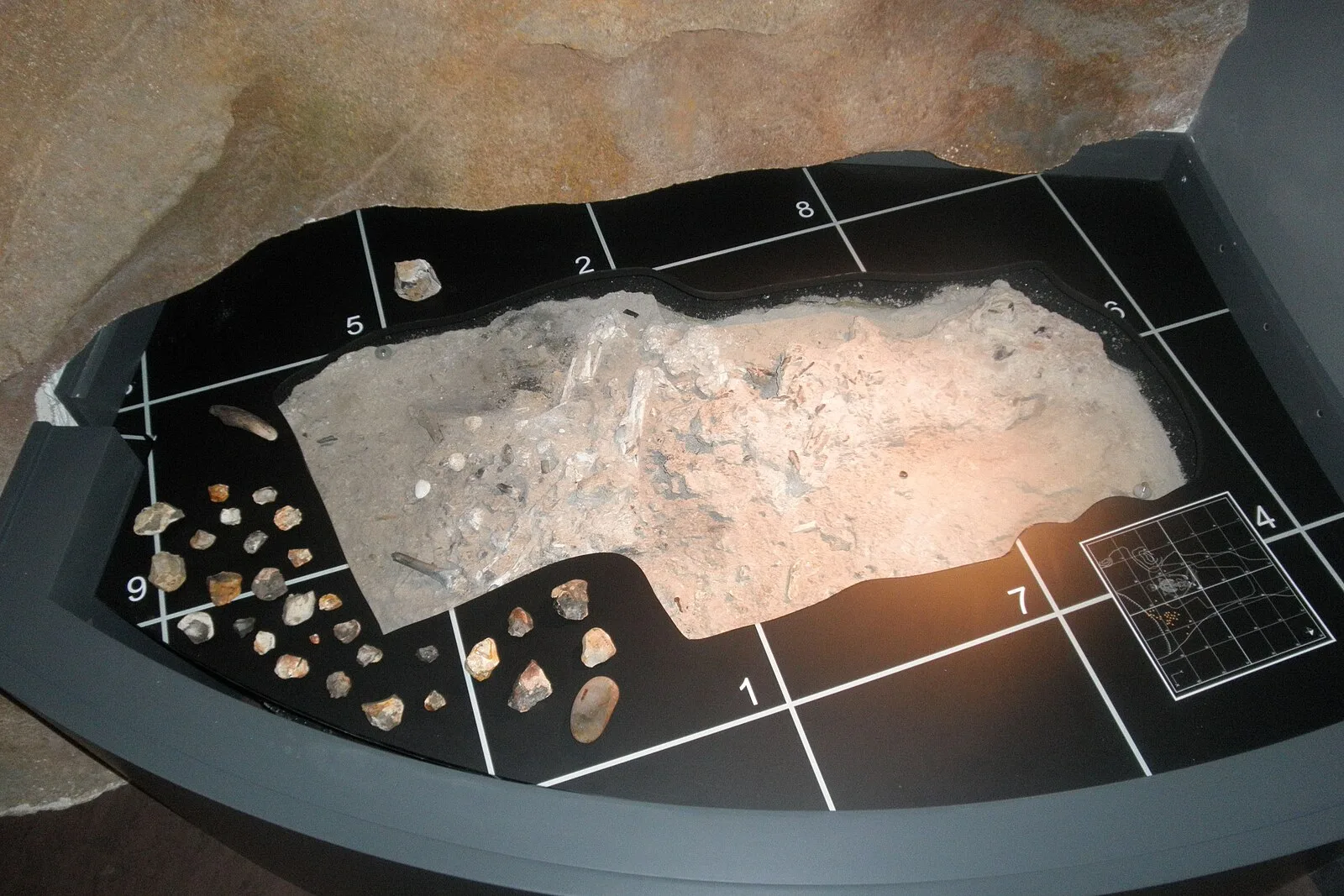
SpainThe La Garma cave complex is a parietal art-bearing paleoanthropological cave system in Cantabria, Spain [1]. The cave complex is noted for one of the best preserved floors from the Paleolithic containing more than 4,000 fossils and more than 500 graphical units [1]. The Lower Gallery of La Garma is situated at 59 m above sea level and is around 300 m in length [1]. It was discovered in November 1995 [1]. Its original entrance was sealed during the Pleistocene by a rockslide about 16,000 years ago, preserving the cave floor in a pristine manner [1]. La Garma is notable for its rich repository of Magdalenian portable art found in The Lower Gallery [1]. The most outstanding artefact is a backward-facing ibex depiction carved onto a bovine rib spatula [1]. The peculiar remains of five Visigothic youths were found deep in the cave system [1].
Text: Wikipedia – 'La Garma cave complex' (revision of 2026-07-18), CC BY-SA 4.0 · sentences selected and shortened by an AI system · source →La Garma Cave Complex
Also known as: Complejo Kárstico del Monte de la Garma, Complex càrstic de la muntanya de la Garma, cova de La Garma, Cueva de La Garma, grottes de La Garma, Hialat carstic deu mont de La Garma, La Garma mendiko multzo karstikoa, מערת לה גרמה, مجموعه غارهای لا گارما, 嘎尔玛洞
| Type | Rock art |
|---|---|
| Period | < 4500 BC |
| Country | Spain |
| Coordinates | 43.4306° N, 3.6658° W |