
 Spain
SpainCueva de La Pasiega, or Cave of La Pasiega, situated in the Spanish municipality of Puente Viesgo, is one of the most important monuments of Paleolithic art in Cantabria [1]. The recorded remains belong mainly to the Upper Solutrean and the Lower Magdalenian ages, although older objects are also found [1]. Throughout the cave are many 'walls' with paintings and with engraved or incised images [1]. There are representations of equines (horses), cervids (deer, male and female) and bovines (cattle) [1]. There are also many abstract symbols (idiomorphs), suggesting patterns of repeated characters [1]. The scientific discovery of the La Pasiega can be credited to Werner and Hugo Obermaier [1].
Text: Wikipedia – 'Cave of La Pasiega' (revision of 2026-07-18), CC BY-SA 4.0 · sentences selected and shortened by an AI system · source →Cave of La Pasiega
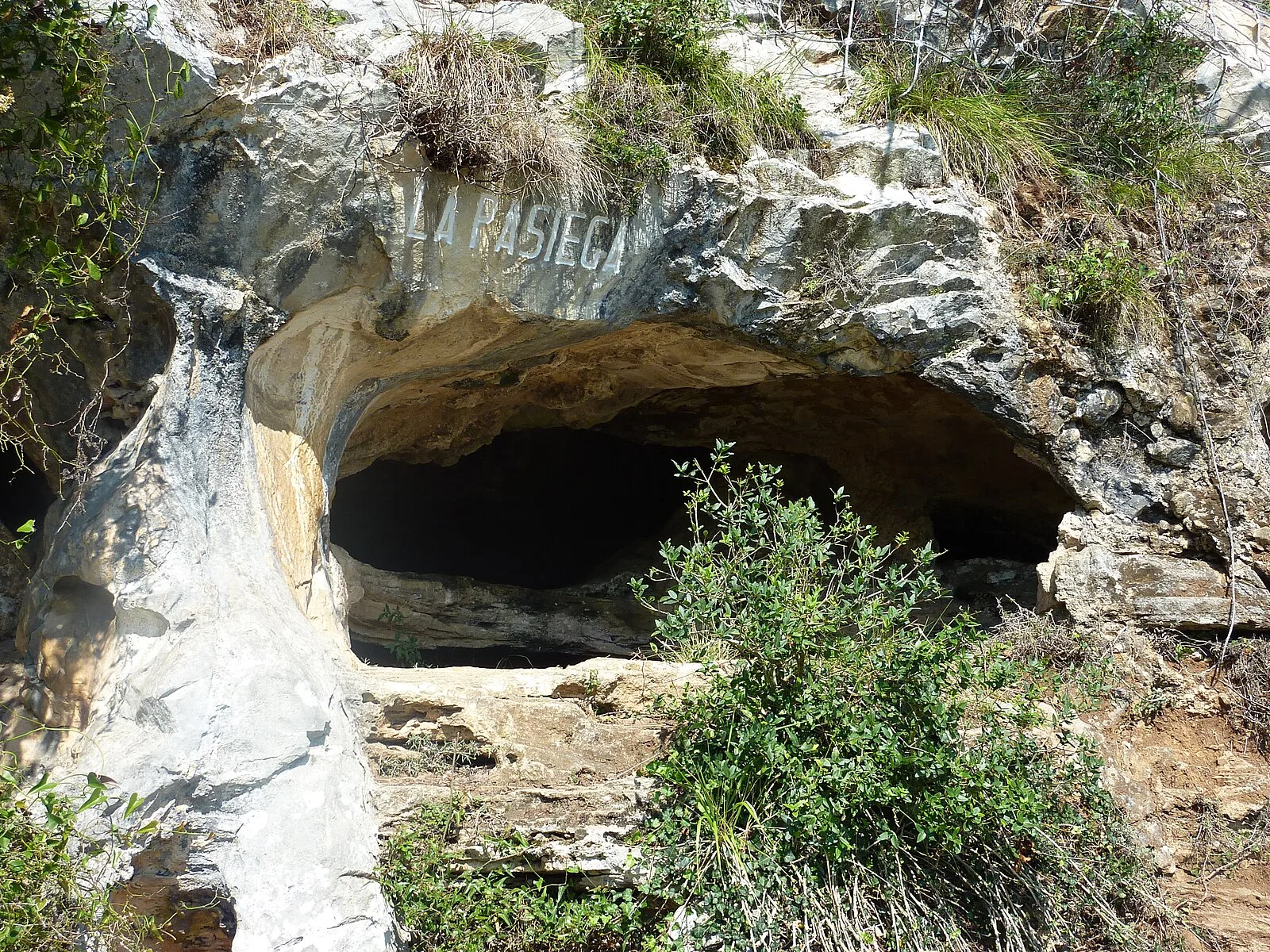
Also known as: Caverna de La Pasiega, Cova de La Pasiega, Cueva de La Pasiega, Grotte de La Pasiaga, Grotte de La Pasiega, Grot van La Pasiega, Höhle von La Pasiega, Kaverno La Pasiega, La Pasiega, La Pasiega leizea, La Pasiega Mağarası, Ла-Пасьега
| Type | Rock art |
|---|---|
| Period | < 4500 BC |
| Country | Spain |
| Coordinates | 43.2891° N, 3.9656° W |