
 Portugal
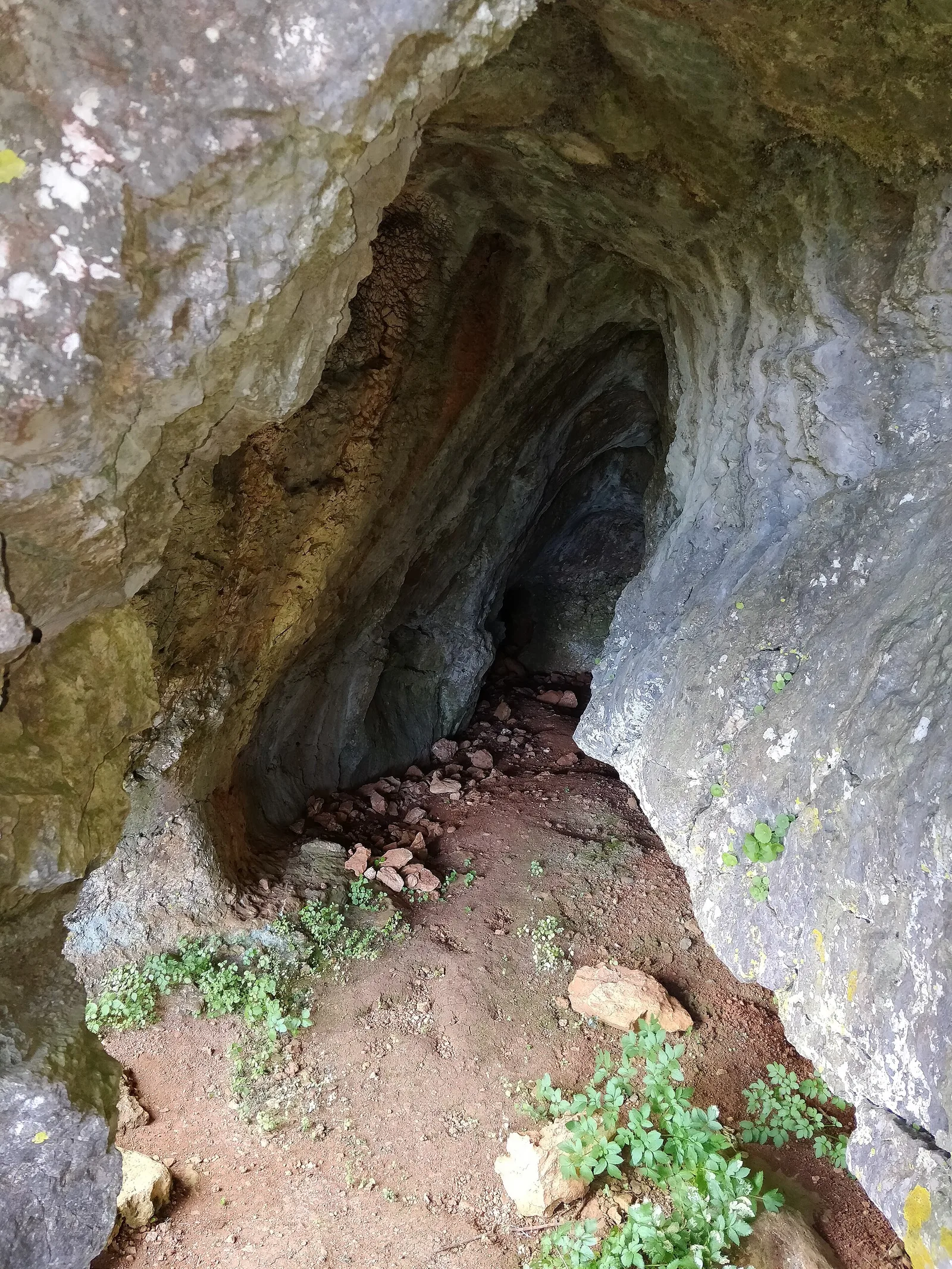
The Cave of Pego do Diabo is a small karst cave in a Turonian limestone outcrop located about 250 metres above sea level in the municipality of Loures, about 20 km north of Lisbon in Portugal [1]. The cave consists of a narrow passage about 13 metres long and one metre wide, with a chamber at the end that is about two metres wide [1]. First officially explored in 1965–66 by the Portuguese Speleological Society, it was surveyed in 1976 by the Grupo para o Estudio do Paleolitico Portugues and at the end of the 1980s by Prof. João Zilhão [1]. The stratigraphic profile carried out by Zilhão identified six layers to a depth of about 1.4 metres [1]. Layer 1 contained a mixture of modern and Pleistocene items while Layer 2 contained artifacts of the Upper Paleolithic associated with animal remains [1]. Work by Maria João Valente analysed the fauna of Layers 1 and 2 associated with the Upper Paleolithic [1]. She noted that the cave contained bones of humans, together with those of wolves, bears, and hyenas, the Iberian lynx and other small carnivores and birds of prey, and their prey such as rabbits [1].
Text: Wikipedia – 'Cave of Pego do Diabo' (revision of 2026-06-29), CC BY-SA 4.0 · sentences selected and shortened by an AI system · source →Cave of Pego do Diabo
| Type | Cave Structures |
|---|---|
| Period | < 4500 BC |
| Country | Portugal |
| Coordinates | 38.8646° N, 9.2183° W |