
 Portugal
The Anta da Estria is a megalithic dolmen situated between Belas and Queluz in the Lisbon District of Portugal [1]. Based on datings of human remains, it is believed to date back to the Late Neolithic and early-Chalcolithic eras (4000-2500 BC) [1]. The Anta da Estria, the Anta do Monte Abraão and the Anta da Pedra dos Mouros are collectively known as the Antas de Belas, and were first identified in the 1870s by Carlos Ribeiro [1]. Carlos Ribeiro, who carried out research in early 1875 and published his results in 1880, described the tomb as having a polygonal chamber, 2–5 metres wide and 2.75 metres high, approached by a corridor bordered by small slabs of limestone [1]. Ribeiro identified nine raised slabs but did not identify any stones that could have formed a roof [1]. Limited artifacts have been discovered at the site but many are thought to have been removed prior to the discovery by Ribeiro [1]. Twelve arrowheads were identified, together with two bone artifacts and three small, almost-complete pots [1].
Text: Wikipedia – 'Anta da Estria' (revision of 2026-07-21), CC BY-SA 4.0 · sentences selected and shortened by an AI system · source →Anta da Estria
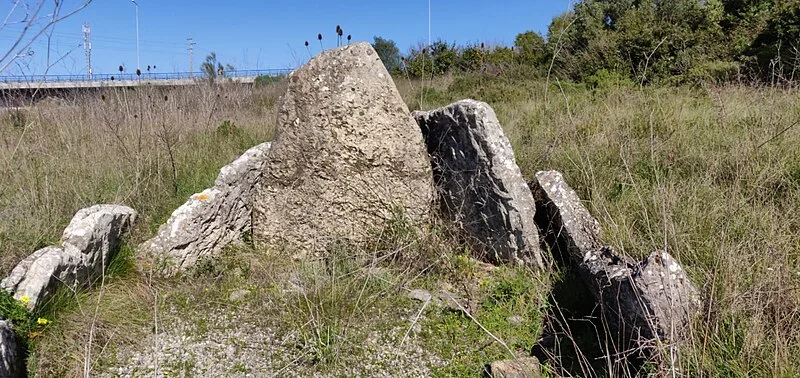
Also known as: Anta de Estria, Antas de Belas, Estria dolmen
| Type | Dolmen |
|---|---|
| Period | 3000 - 1500 BC |
| Country | Portugal |
| Coordinates | 38.7699° N, 9.2674° W |