
 Portugal
The Anta de Agualva, also known as the Anta do Carrascal, is a megalithic dolmen situated in an urban area of Agualva-Cacém in the municipality of Sintra, in the Lisbon District of Portugal [1]. The dolmen is believed to have been made up of a polygonal chamber measuring 3.7 × 3.8 meters and formed by seven vertical stones (orthostats), together with an access corridor [1]. The artifacts collected, as well as more recent radiocarbon dating, suggest that the chamber was used in the Late Neolithic period between the middle and end of the 4th millennium BC [1]. Later, in the second half of the 3rd millennium or in the second millennium, additional funerary deposits may have been made in the access corridor [1]. The Anta de Agualva was first identified in 1875 by military engineer and geologist Carlos Ribeiro who excavated this site as well as several other dolmens in the area to the northeast of Lisbon, such as the Anta da Estria, Anta da Pedra dos Mouros, Anta das Pedras Grandes, and Anta do Monte Abraão [1]. The dolmen was registered as a national monument in 1910 [1].
Text: Wikipedia – 'Anta de Agualva' (revision of 2026-07-21), CC BY-SA 4.0 · sentences selected and shortened by an AI system · source →Anta de Agualva
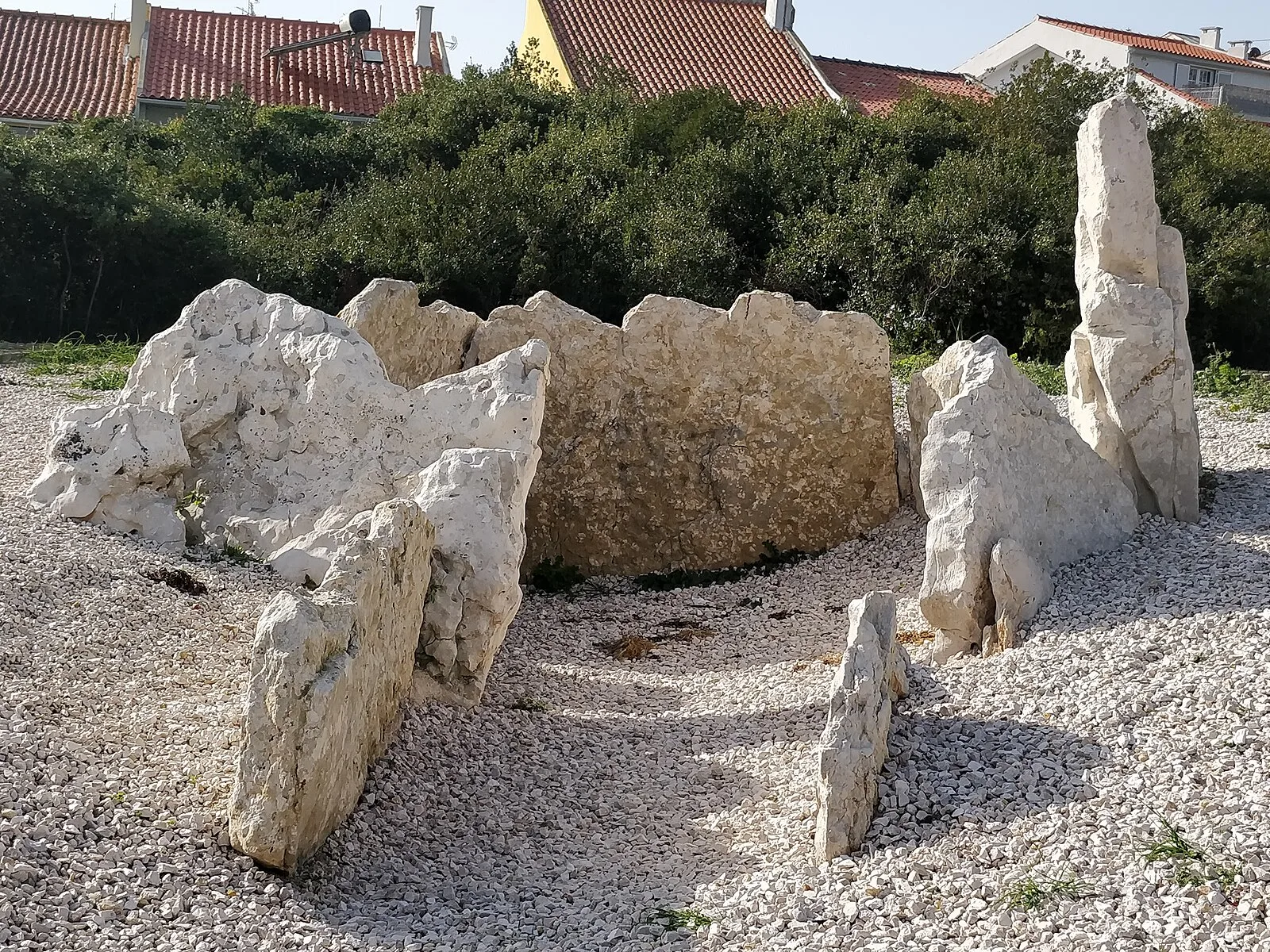
Also known as: Agualva dolmen, Anta da Agualva, anta da Carrascal, Anta do Carrascal, Carrascal dolmen
| Type | Dolmen |
|---|---|
| Period | 4500 - 3000 BC |
| Country | Portugal |
| Coordinates | 38.7735° N, 9.2869° W |