
 Portugal
The Anta do Monte Abraão was a megalithic dolmen located in the parish of Monte Abraão, in Queluz, Sintra Municipality, Lisbon District [1]. The dolmen was first identified in 1876, by Carlos Ribeiro, who carried out excavations until 1878 and published his results in 1880 [1]. Excavations suggest that it served as a tomb for about 80 individuals and that it dates back to the middle to end of the Neolithic period (4000-2500 BC) [1]. The burial chamber of the Anta do Monte Abraão had an east-west orientation [1]. It had at least six upright limestone supporting stones or orthostats and three of these were found in situ by Ribeiro [1]. The polygonal chamber had a diameter of 3.6 metres, approached by an 8 metre corridor that was 2 metres wide [1]. Despite the destruction of the tomb, excavations have yielded numerous finds, including stone axes, flint tools and blades, flint arrowheads, club heads, pottery ceramics, clay vessels and objects of adornment [1]. These are exhibited at the Portuguese Geological Museum in Lisbon [1].
Text: Wikipedia – 'Anta do Monte Abraão' (revision of 2026-07-21), CC BY-SA 4.0 · sentences selected and shortened by an AI system · source →Anta do Monte Abraão
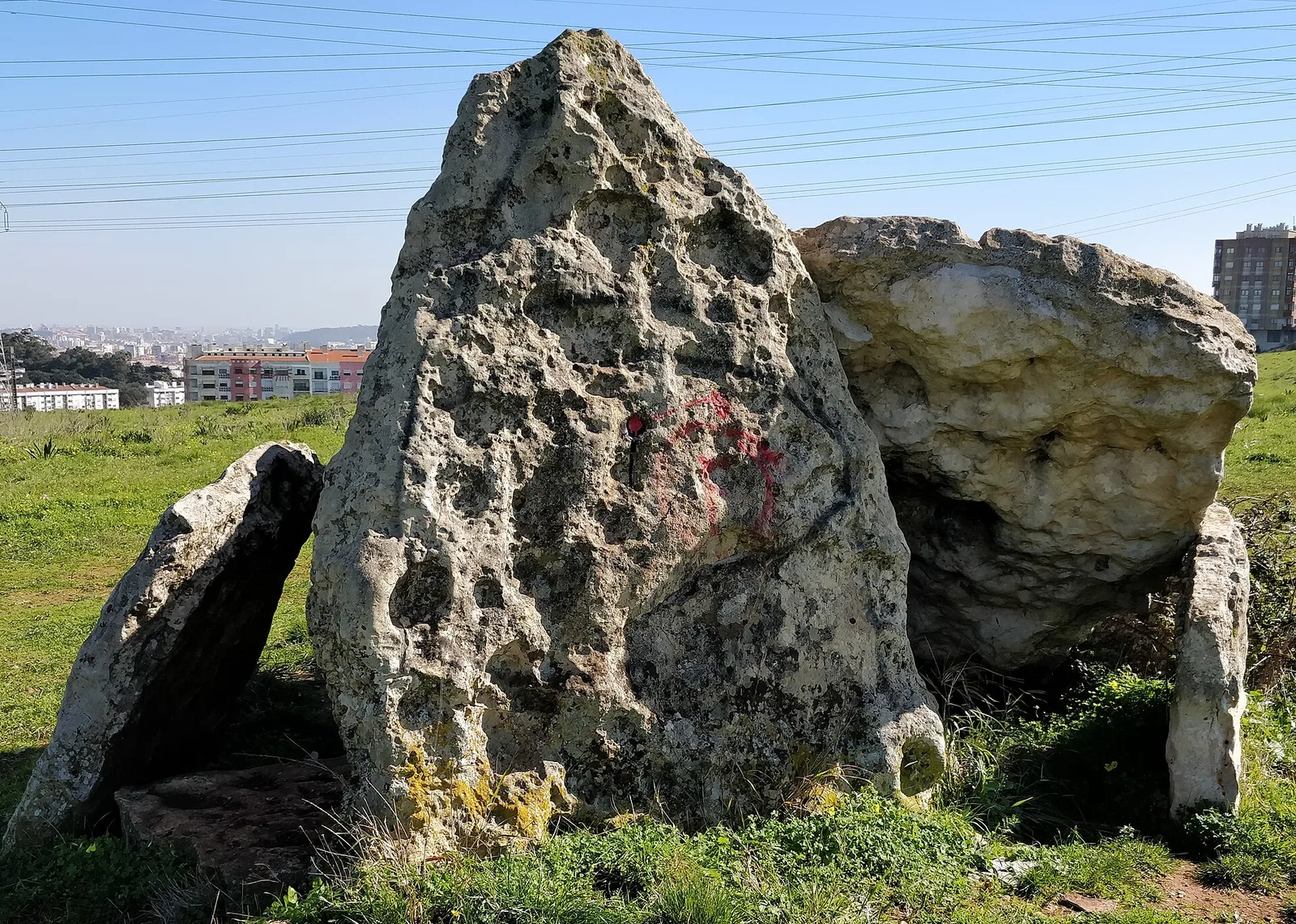
Also known as: Anta de Monte Abraão
| Type | Dolmen |
|---|---|
| Period | 4500 - 3000 BC |
| Country | Portugal |
| Coordinates | 38.7683° N, 9.2647° W |