
 Ireland
Knockmaree Dolmen, or Knockmaree Cist, is a prehistoric site of the Neolithic period, in Phoenix Park just north of Chapelizod, near Dublin, Ireland [1]. The tomb, situated on a small ridge, is a cist, a type of burial chamber found in Ireland on the south and east coast [1]. It dates from about 3000 B.C. to 2500 B.C. A capstone, measuring 1.96 metres (6 ft 5 in) by 1.05 metres (3 ft 5 in), is supported by smaller stones [1]. The capstone is water-worn, and is thought to have come from the River Liffey nearby [1]. It was discovered in 1838, when workmen were employed to remove a tumulus of height 15 feet (4.6 m) and circumference 120 feet (37 m) [1]. In the centre of the mound were found the stones now visible; four other cists were found in the outer area [1]. The remains were examined by the Royal Irish Academy, the Academy's report later being delivered by George Petrie [1].
Text: Wikipedia – 'Knockmaree Dolmen' (revision of 2026-07-18), CC BY-SA 4.0 · sentences selected and shortened by an AI system · source →Knockmaree Dolmen
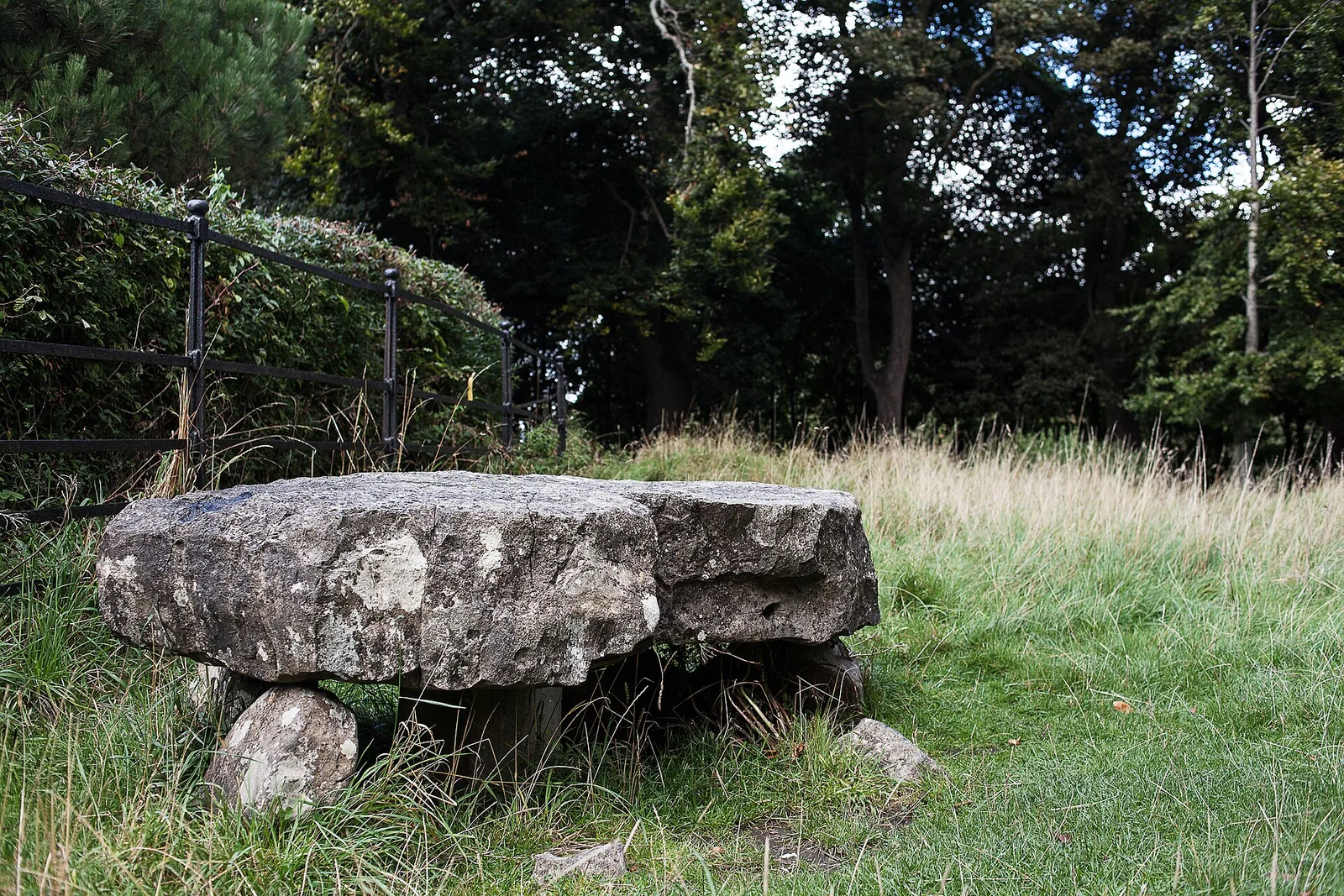
Also known as: Knockmaroon Dolmen, Knockmaroon Kist, Knockmary Dolmen, Linkardstown Tomb, Steinkiste von Knockmaree
| Type | Dolmen |
|---|---|
| Period | 3000 - 1500 BC |
| Country | Ireland |
| Coordinates | 53.3510° N, 6.3405° W |