
 Ireland
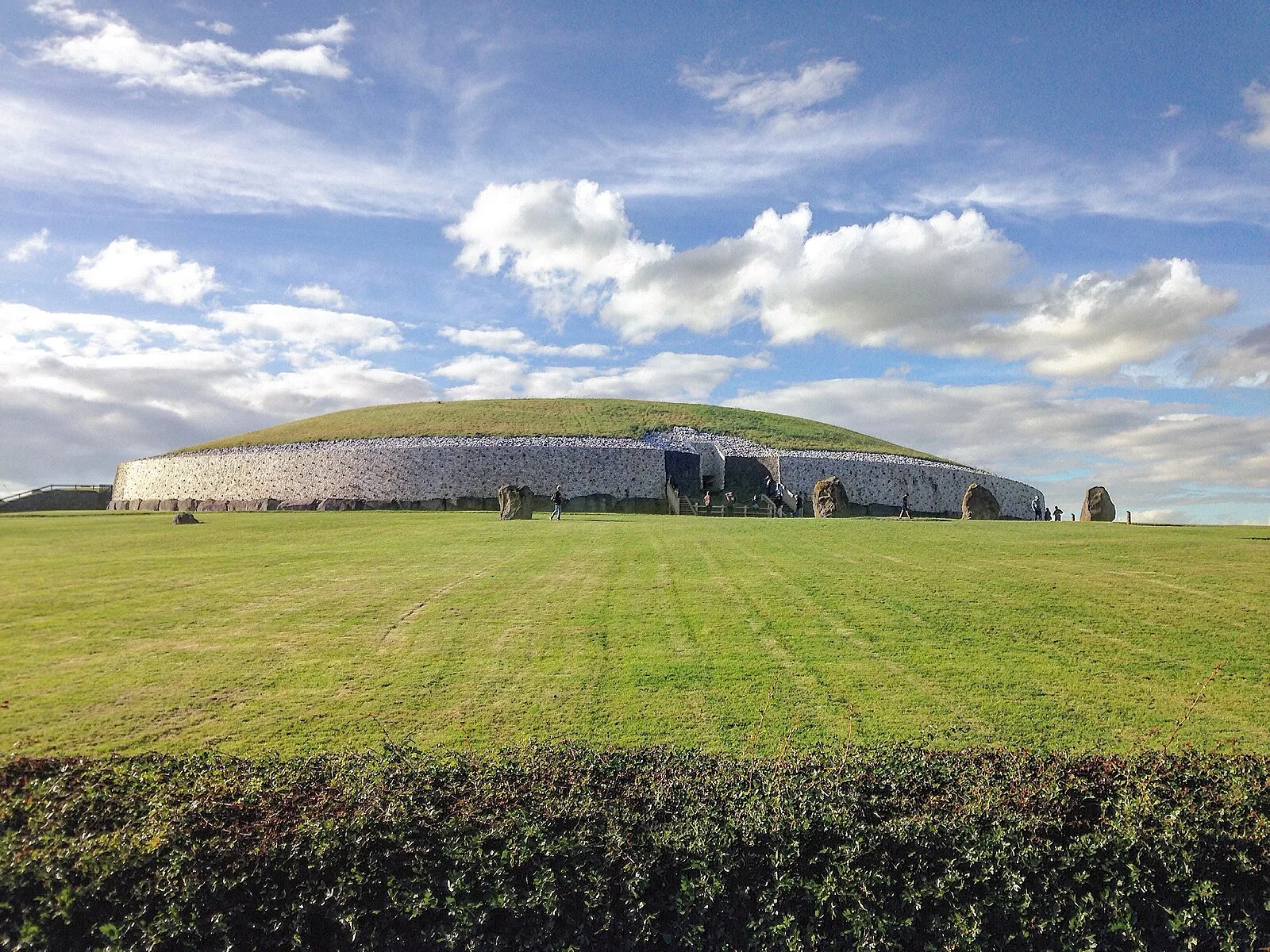
Newgrange is a prehistoric monument in County Meath in Ireland, placed on a rise overlooking the River Boyne [1]. Newgrange is the main monument in the Brú na Bóinne complex, a World Heritage Site that also includes the passage tombs of Knowth and Dowth, as well as other henges, burial mounds and standing stones [1]. Newgrange consists of a large circular mound with an inner stone passageway and cruciform chamber [1]. Burnt and unburnt human bones and possible grave goods or votive offerings were found in this chamber [1]. The monument has a striking façade made mostly of white quartz cobblestones and ringed by engraved kerbstones [1]. Many of the larger stones of Newgrange are covered in megalithic art [1]. The mound is 85 metres wide at its widest point and 12 metres high, and covers 4,500 square metres of ground [1]. Excavations in the late 1960s and early 1970s revealed seven "marbles", four pendants, two beads, a used flint flake, a bone chisel, and fragments of bone pins and points [1].
Text: Wikipedia – 'Newgrange' (revision of 2026-08-05), CC BY-SA 4.0 · sentences selected and shortened by an AI system · source →Newgrange
Also known as: 뉴그레인지, Arheološko nalazište Boyne, Bend of the Boyne, New Grange, Newgrangen hautakumpu, Newgrangen käytävähauta, New Grangen käytävähauta, Newgrange Passage Tomb, Niugrendžas, Ņūgreindža, Sí an Bhrú, Tempel von Newgrange
| Type | Necropolis/tombs complex |
|---|---|
| Period | 4500 - 3000 BC |
| Country | Ireland |
| Coordinates | 53.6949° N, 6.4755° W |