
 Ireland
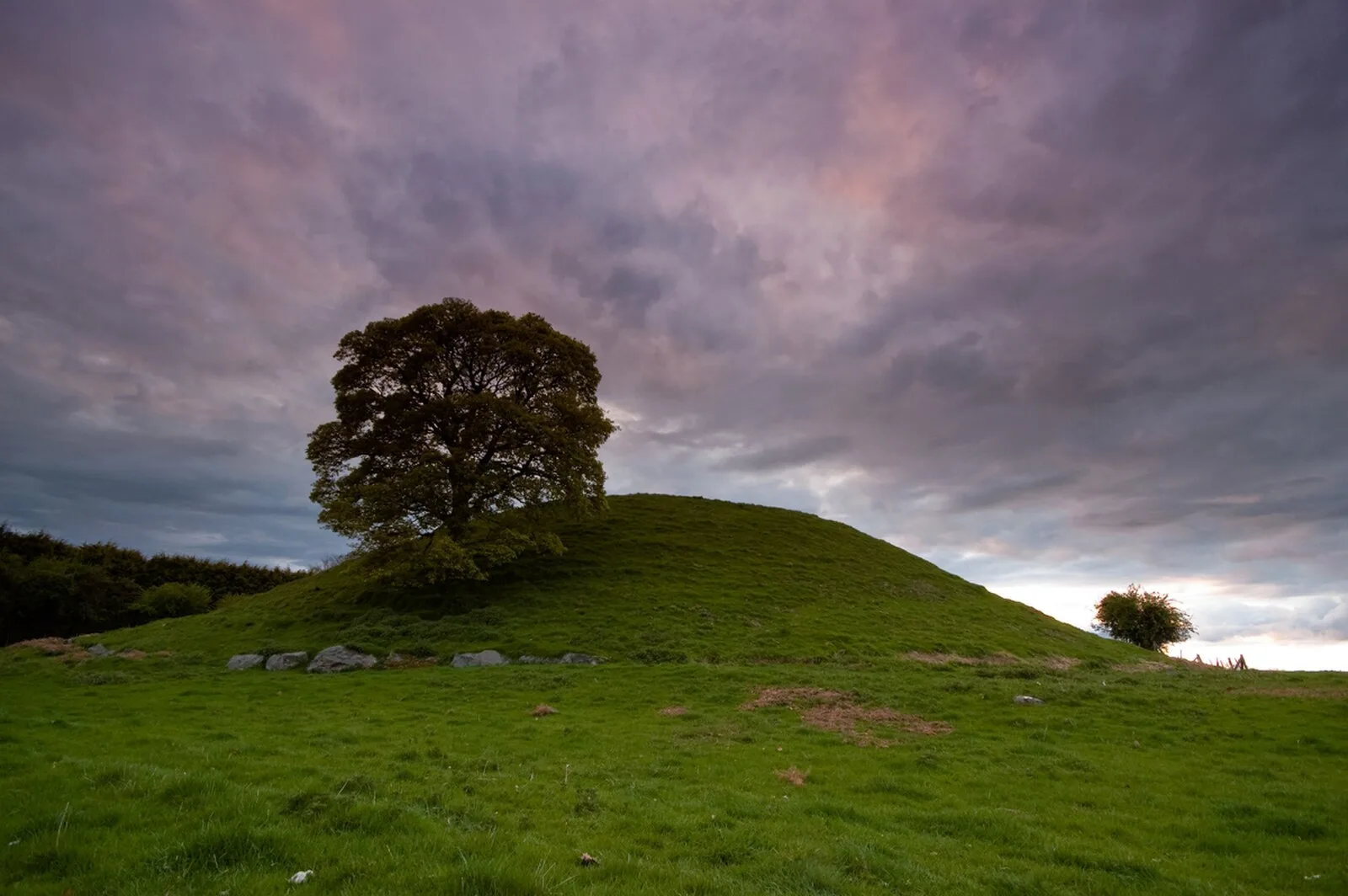
Dowth is the site of Neolithic passage tombs near the River Boyne in County Meath, Ireland [1]. It is one of the three main tombs of the Brú na Bóinne World Heritage Site, along with Newgrange and Knowth [1]. Unlike its neighbours, Dowth has mostly been left as a ruin, although its smaller inner chambers are largely intact [1]. The Royal Irish Academy carried out a botched excavation in 1847, leaving a large crater in the mound that has never been repaired [1]. The cairn or tumulus is about 85 metres in diameter and 15 metres high, and surrounded by large kerbstones, some of which are decorated [1]. Three stone-lined passages lead into the mound from the west [1]. These comprise two passage tombs (known as Dowth North and Dowth South) and a souterrain [1]. The longest of the passages (Dowth North) is 18.2 metres in length and is crossed by 3 sill-stones and ends in a cruciform chamber with a lintelled (not corbelled as in Newgrange or Knowth) roof [1].
Text: Wikipedia – 'Dowth' (revision of 2026-08-02), CC BY-SA 4.0 · sentences selected and shortened by an AI system · source →Dowth
Also known as: Dowth Passage Tomb, Dowth Tumulus, Dubhadh, Даут, دوث, ドウス (遺跡), 唐思墓
| Type | Necropolis/tombs complex |
|---|---|
| Period | 4500 - 3000 BC |
| Country | Ireland |
| Coordinates | 53.7038° N, 6.4501° W |