
 Ireland
Labbacallee Wedge Tomb (Irish: Leaba Chaillí, meaning 'hag's bed') is a large pre-historic burial monument, located 8 km north-west of Fermoy and 2 km south-east of Glanworth, County Cork, Ireland [1]. It is the largest Irish wedge tomb and dates from roughly 2300 BC [1]. The tomb has three massive capstones, with the largest weighing 10 tonnes, and three large buttress stones at the back [1]. The burial area consists of a long chamber, divided by a large vertical slab into two areas of unequal length [1]. Access to both chambers was only possible by the removal of the end capstone [1]. Labbacallee Wedge Tomb was one of the first sites excavated under the new National Monuments Act by Harold Leask and Liam Price in 1934 [1]. The excavations revealed a number of burials, fragments of a late Stone Age decorated pot, and fragments of bone and stone [1].
Text: Wikipedia – 'Labbacallee wedge tomb' (revision of 2026-06-21), CC BY-SA 4.0 · sentences selected and shortened by an AI system · source →Labbacallee Wedge Tomb
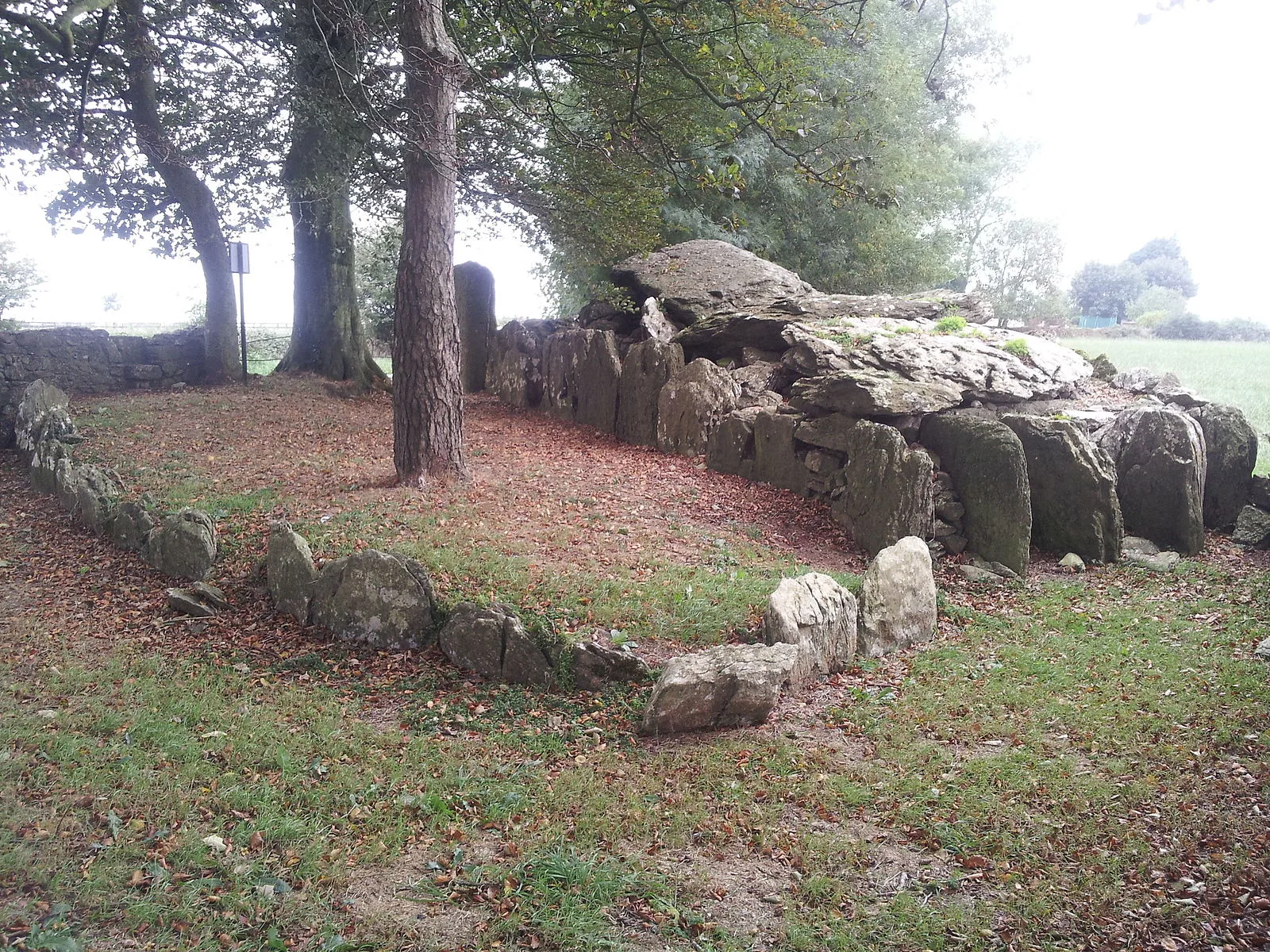
Also known as: Labbacallee, Leaba Chaillí
| Type | Necropolis/tombs complex |
|---|---|
| Period | 3000 - 1500 BC |
| Country | Ireland |
| Coordinates | 52.1743° N, 8.3344° W |