
 Greece
During the prehistory of Southeastern Europe, Sesklo was a significant settlement of Neolithic Greece, before the advent of the Bronze Age and millennia before the Mycenaean period [1]. The settlement at Sesklo gives its name to the earliest known Neolithic culture of Europe, which inhabited Thessaly and parts of Macedonia [1]. The Neolithic settlement was discovered in the 19th century and the first excavations were made by the Greek archaeologist Christos Tsountas [1]. The oldest fragments researched at Sesklo place development of the culture as far back as c. 7510 BC — c. 6190 BC, known as proto-Sesklo and pre-Sesklo [1]. They show advanced agriculture and a very early use of pottery that rivals in age those documented in the near east [1]. The Neolithic settlement of Sesklo covered an area of approximately 20 hectares during its peak period at c. 5000 BC and comprised about 500 to 800 houses with a population estimated potentially, to be as large as 5,000 people [1].
Text: Wikipedia – 'Sesklo' (revision of 2026-09-20), CC BY-SA 4.0 · sentences selected and shortened by an AI system · source →Sesklo
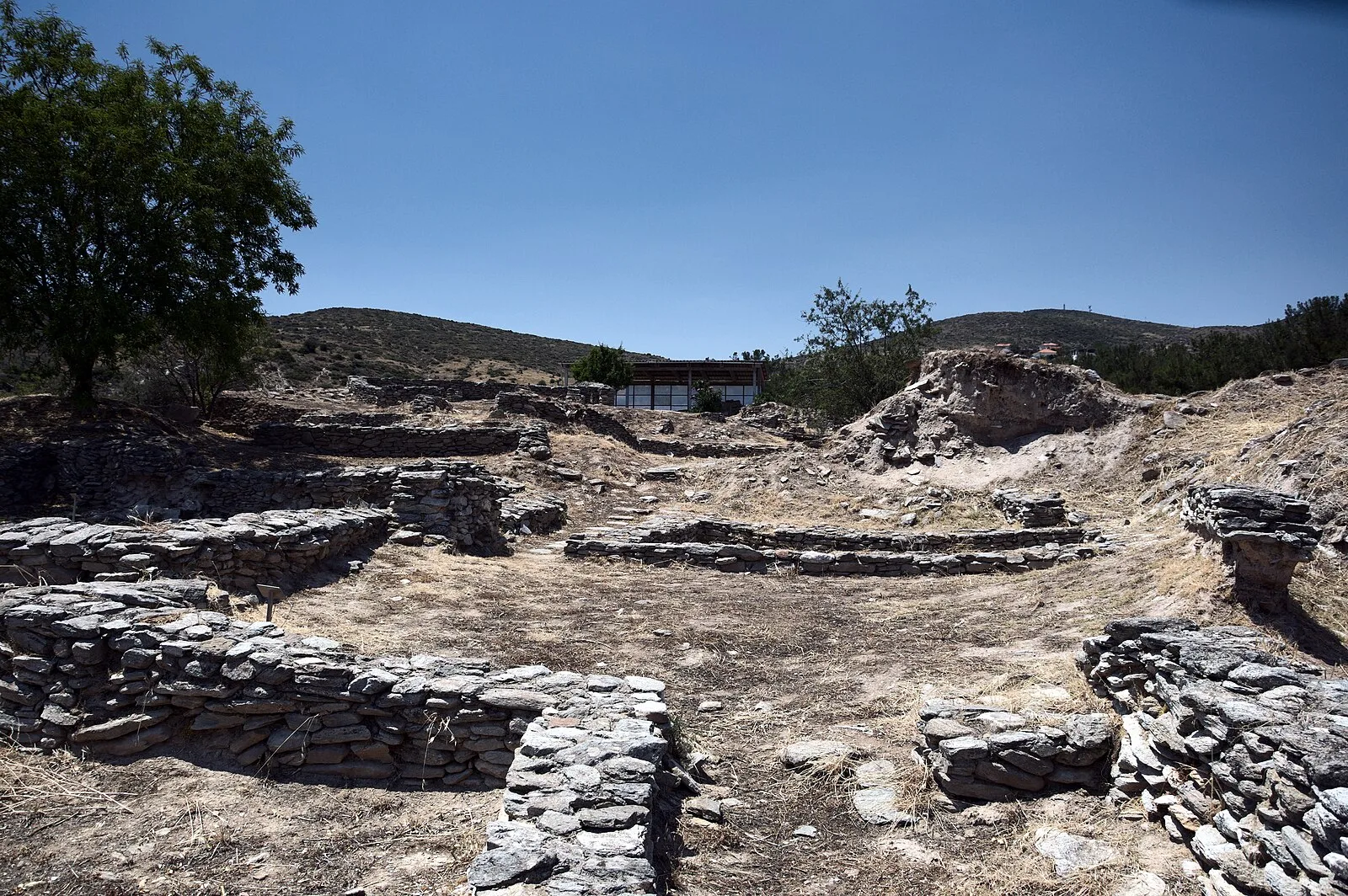
Also known as: Sesclum (oppidum neolithicum), Sesklas, Sesklo archaeological site, Sesklo (archeologische vindplaats), Sesklo Arkeolojik Alanı, Sesklo aztarnategi arkeologiko, Sesklo (dorp), Sesklo régészeti lelőhely, Μέγαρο νεολιθικής εποχής στο Σέσκλο, Σέσκλο, Σέσκλο Μαγνησίας, Сескла
| Type | City/town/settlement |
|---|---|
| Period | < 4500 BC |
| Country | Greece |
| Coordinates | 39.3552° N, 22.8350° E |