
 Greece
Cranon or Crannon was a town and polis (city-state) of Pelasgiotis, in ancient Thessaly, situated southwest of Larissa, and at the distance of 100 stadia from Gyrton, according to Strabo [1]. After the Battle of Chaeronea (338 BCE), the Phocians fought in Lamia and in the Battle of Crannon against Antipater and his army [1]. This was the decisive battle of the Lamian War between Macedon and Athens with its allies [1]. In 191 BCE, Crannon was taken by Selecuid king Antiochus III [1]. The first epigraphic reference to the polis of the Cranionians is in an honorific decree of the 3rd century BCE [1]. At an indeterminate date Cranon was a walled and fortified city, but almost nothing is known about the urban centre and the acropolis, except for a possible temple of Athena Polias erected on it [1]. There were also temples of Aesclepius, Apollo, Poseidon and Zeus [1]. The city minted silver coins in the fifth century BCE (480-400 BCE) and bronze coins in the fourth century BCE [1].
Text: Wikipedia – 'Cranon' (revision of 2025-07-01), CC BY-SA 4.0 · sentences selected and shortened by an AI system · source →Cranon
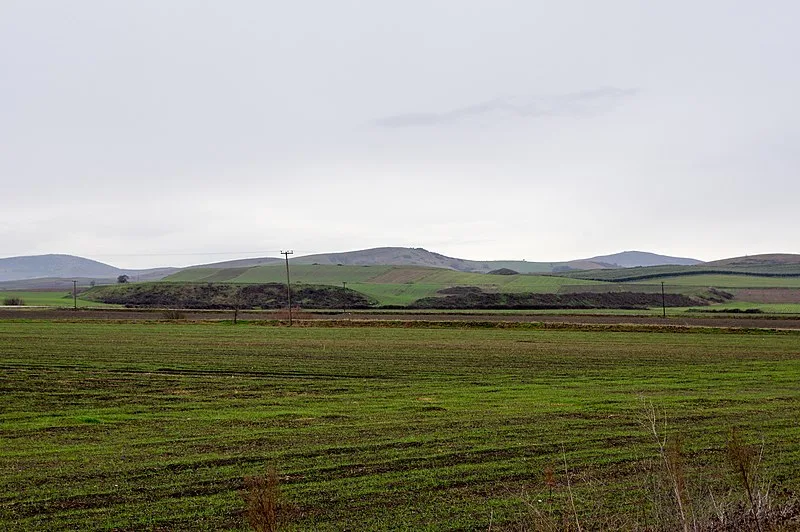
Also known as: Crannó, Crannon, Krannon, Kranon, Mint of Crannon, Κραννών, Краннон, کرانون
| Type | City/town/settlement |
|---|---|
| Period | 3000 - 1500 BC |
| Country | Greece |
| Coordinates | 39.5007° N, 22.3025° E |