
 Greece
Samicum or Samikon was a town of Triphylia in ancient Elis, situated near the coast about half-way between the mouths of the Alpheius and the Neda, and a little north of the Anigrus [1]. It stood upon a projecting spur of a lofty mountain, which here approaches so near the coast as to leave only a narrow pass [1]. Samicum was occupied by the Aetolian Polysperchon against the Arcadians, and was taken by Philip V of Macedon in 219 BCE [1]. Near Samicum upon the coast was a celebrated temple of the Samian Poseidon, surrounded by a grove of wild olives [1]. It was the centre of the religious worship of the six Triphylian cities, all of whom contributed to its support [1]. The ruins of Samicum are found at Kleidi Hill near Kato Samiko [1]. The ruined walls are 6 feet (2 m) thick, and about 1.5 miles (2.4 km) in circumference [1]. The remains found on Kleidi Hill include cyclopean walls and remnants of a settlement that was occupied in the middle and late Helladic periods [1].
Text: Wikipedia – 'Samicum' (revision of 2026-03-24), CC BY-SA 4.0 · sentences selected and shortened by an AI system · source →Samicum
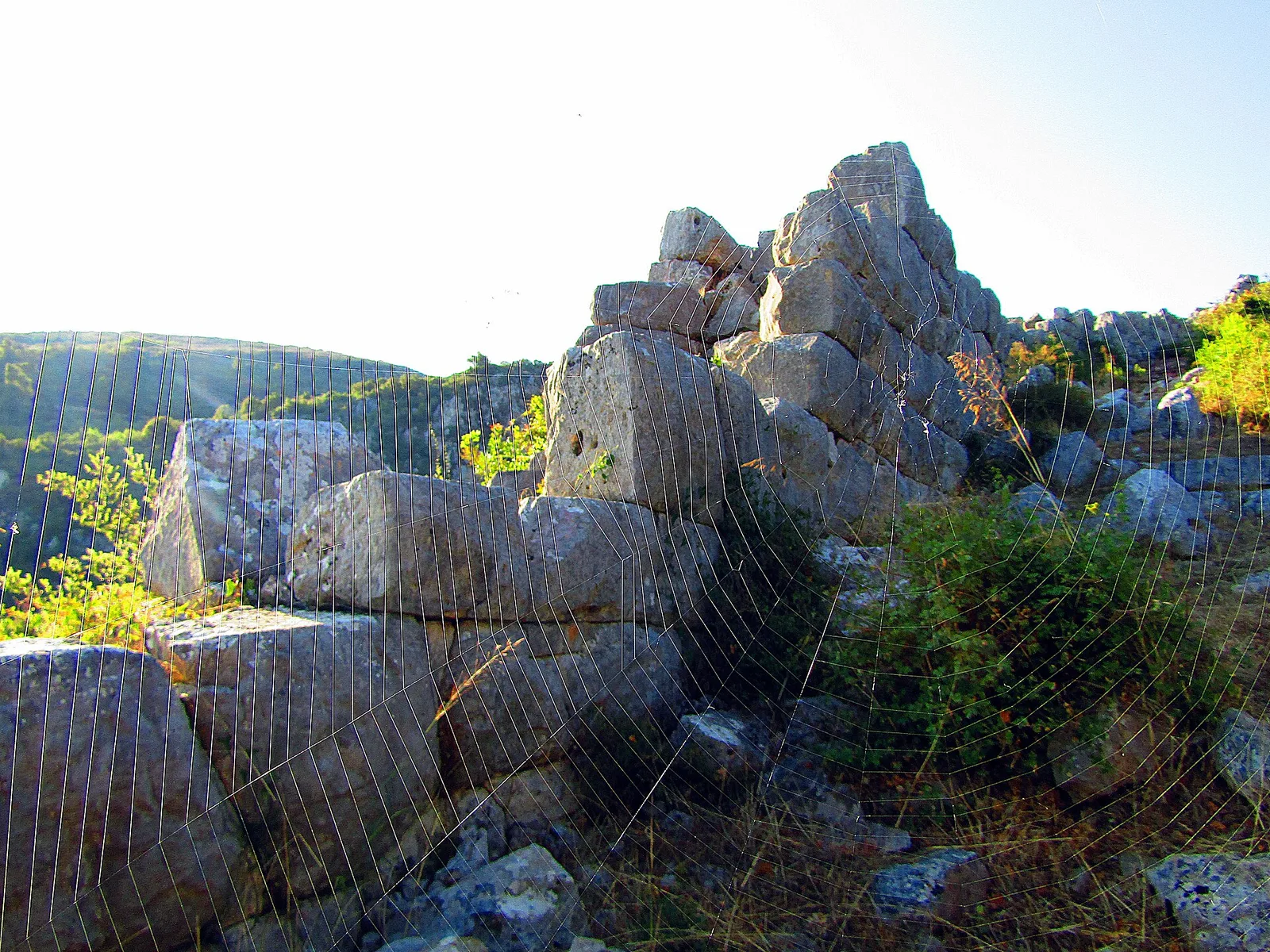
Also known as: Ali Çelebi Kalesi, Sámico, Sàmicon, Samiko, Samikon, Αρήνη, Κάτω Σαμικό, Μάκιστος, Σάμη, Σαμία, Σαμικό, Σαμικό (αρχαία πόλη)
| Type | City/town/settlement |
|---|---|
| Period | 500 BC - 1 AD |
| Country | Greece |
| Coordinates | 37.5341° N, 21.5986° E |