
 Greece
The Prince of the Lilies is a celebrated Minoan relief fresco excavated by Sir Arthur Evans from the palace of Knossos on Crete, dated to c. 1550 BC. The life-size figure wears a crown of lilies and peacock feathers, a Minoan kilt, and a beaded necklace, with reddish-brown skin following Minoan artistic convention. Created using lime plaster mixed with sand for a three-dimensional effect, the work was reconstructed from three non-joining fragments. Modern scholars widely dispute Evans' reconstruction, noting the fragments may represent separate figures, and the headdress may have belonged to a sphinx rather than a human. The original is in the Heraklion Archaeological Museum.
Prince of the Lilies
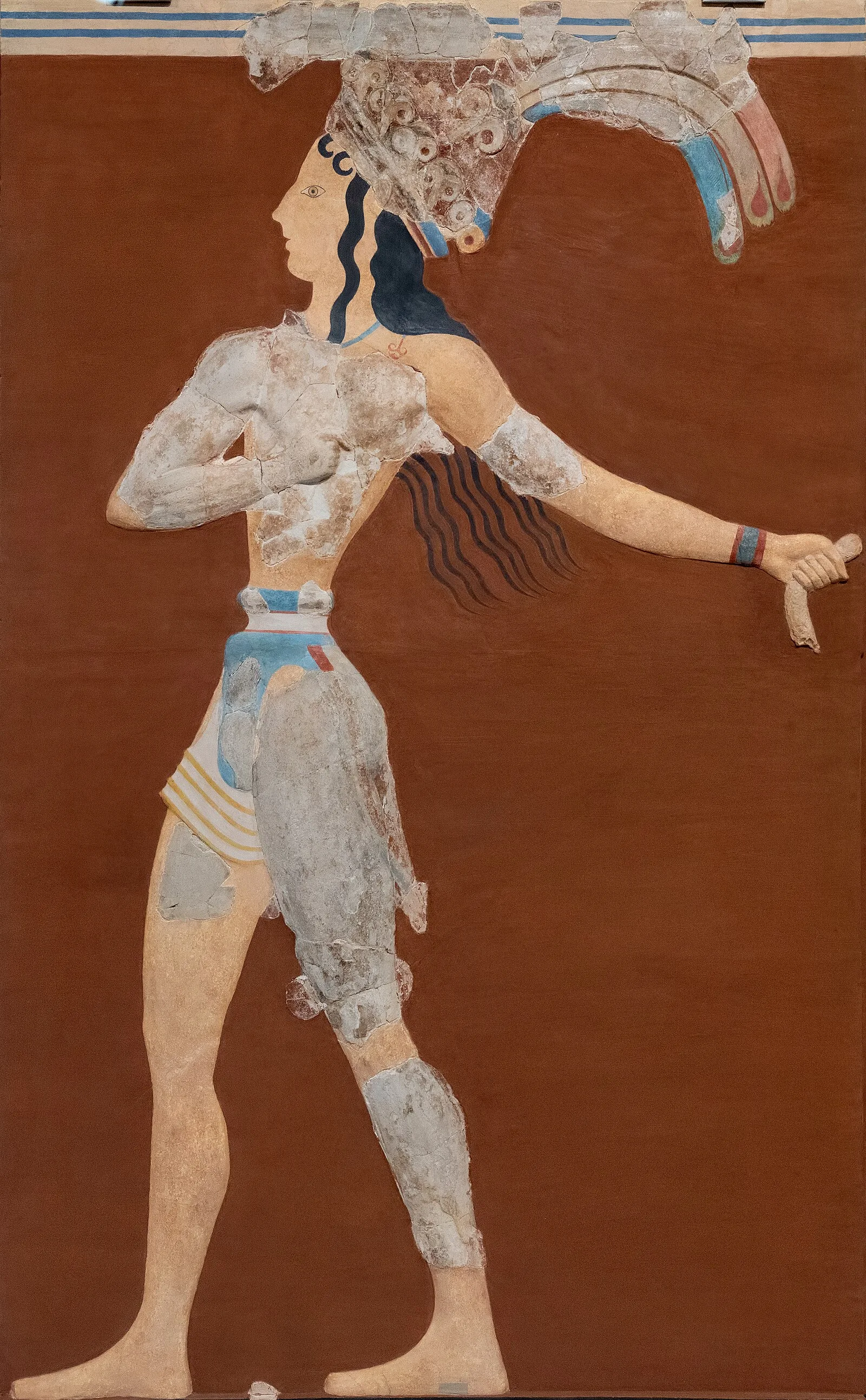
Also known as: Książę wśród lilii, Prince des Lys, Príncep dels lliris, Principe dei gigli, Principe de los lirios, Prins van de lelies, Принц з ліліями, Принц із ліліями, Принц с лилиями, Прынц з лілеямі, Царь-жрец (фреска), ලිලී මල් කුමරු
| Type | Archaeological site |
|---|---|
| Period | 3000 - 1500 BC |
| Country | Greece |
| Coordinates | 35.2980° N, 25.1634° E |