
 Greece
Knossos lies on Kephala hill, in the valley of the Kairatos river, within the modern municipality of Heraklion, about 5 km south of the historic centre [1]. The earliest known settlement at Knossos dates to about 7000 BC, during the early Neolithic period [1]. The first palace at Knossos was constructed around 1900 BC [1]. The Second Palace period, from about 1700 to 1450 BC, was the height of Minoan Knossos [1]. After about 1450 BC, Knossos became an important Mycenaean administrative centre [1]. In the Archaic and Classical periods, Knossos was a major Cretan city-state [1]. In 1900, Arthur Evans began large-scale excavations at Knossos [1]. The Palace of Minos is the dominant archaeological feature at Knossos [1].
Text: Wikipedia – 'Knossos' (revision of 2026-09-14), CC BY-SA 4.0 · sentences selected and shortened by an AI system · source →Knossos
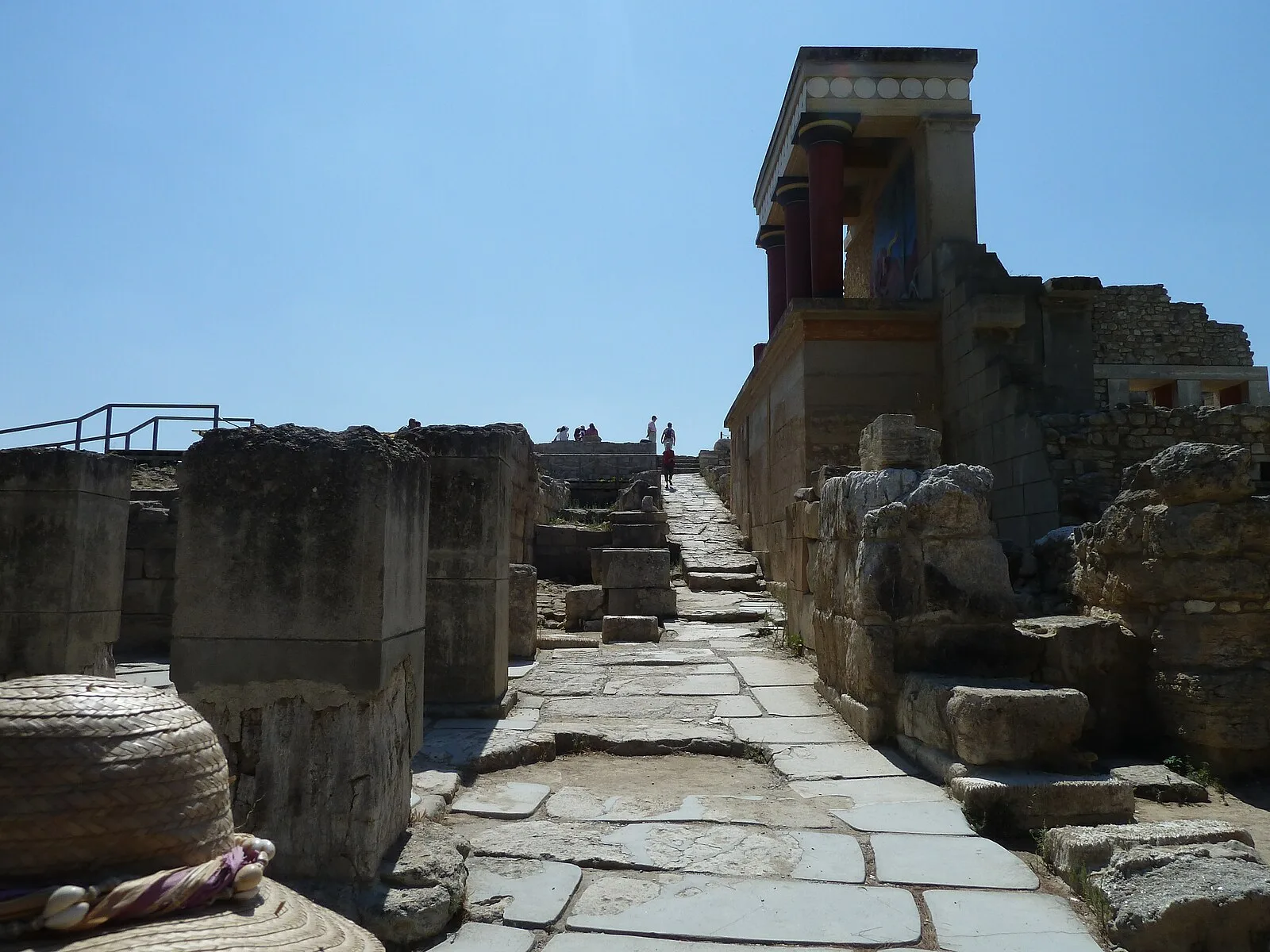
Also known as: 크노소스, Cnosos, Cnosso, Cnossos, Cnossus, Cnosus, Gnosos, Gnossus, Knos, Knosas pils, Knoso rūmai, Knosos
| Type | City/town/settlement |
|---|---|
| Period | < 4500 BC |
| Country | Greece |
| Coordinates | 35.2982° N, 25.1630° E |