
 England
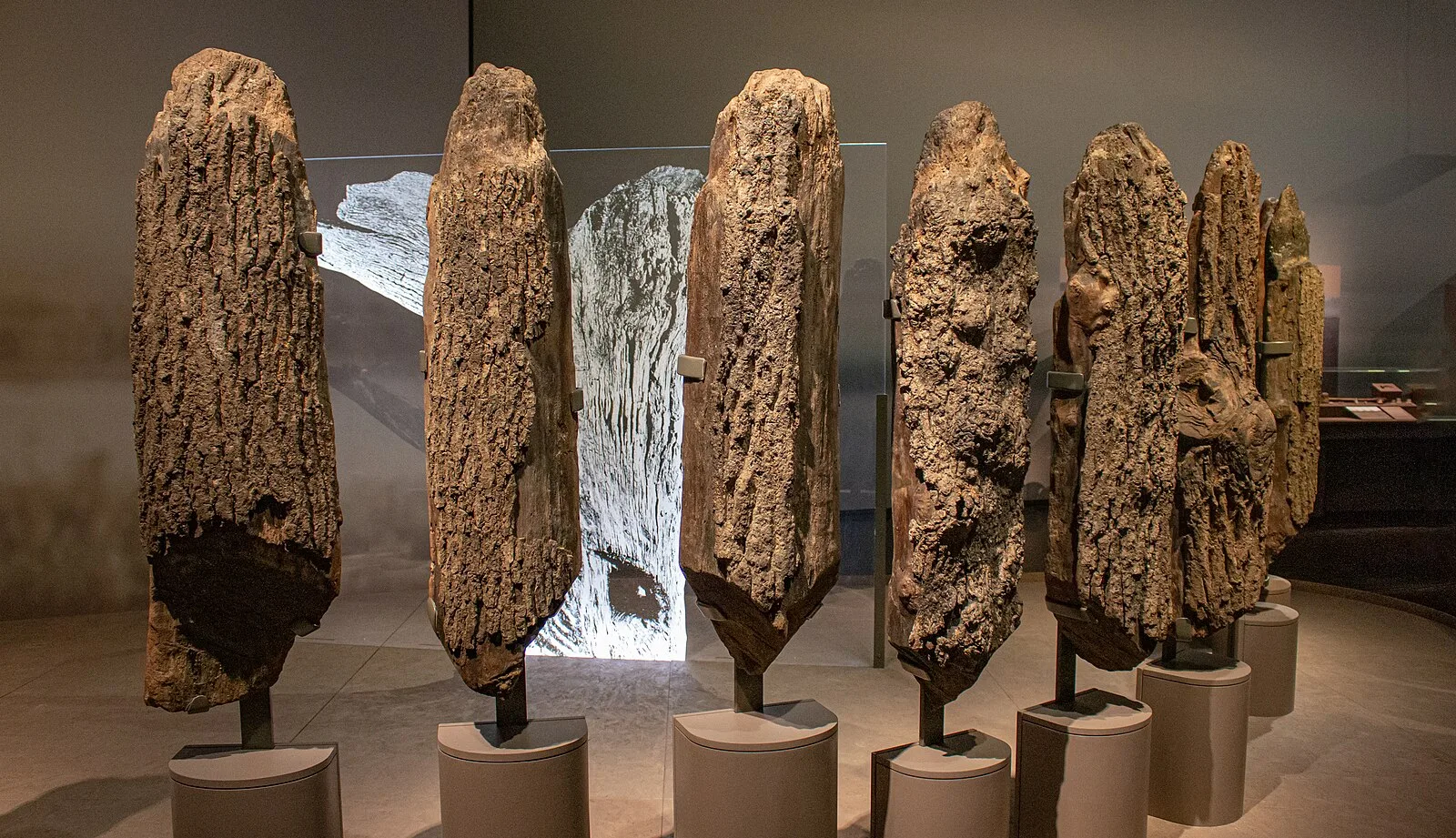
Seahenge, also known as Holme I, was a prehistoric monument located in the village of Holme-next-the-Sea, near Old Hunstanton in the English county of Norfolk [1]. A timber circle with an upturned tree root in the centre, Seahenge, along with the nearby timber circle Holme II, was built in the spring-summer of 2049 BC [1]. The site consisted of an outer ring comprising 55 small split oak trunks forming a roughly circular enclosure around 7 by 6 metres [1]. Rather than being placed in individual holes, the timbers had been arranged around a circular construction trench [1]. Their split sides faced inwards and their bark faced outwards (with one exception where the opposite is the case) [1]. One of the trunks on the south western side had a narrow Y fork in it, permitting access to the central area [1]. Seahenge was originally constructed on a salt marsh, and over the centuries the area became a freshwater wetland, as an offshore barrier grew up, preventing sea water from getting access to the area around the circle [1].
Text: Wikipedia – 'Seahenge' (revision of 2026-07-19), CC BY-SA 4.0 · sentences selected and shortened by an AI system · source →Seahenge
Also known as: Holme I, Holme I, Syhendžas, Сихендж, シーヘンジ
| Type | Timber circle |
|---|---|
| Period | 3000 - 1500 BC |
| Country | England |
| Coordinates | 52.9682° N, 0.5214° E |