
 England
Uxelodunum (with the alternative Roman name of Petriana and the modern name of Stanwix Fort) was a Roman fort with associated civilian settlement in modern-day Carlisle, Cumbria, England [1]. It was the largest fort on Hadrian's Wall and is now buried beneath the suburb of Stanwix [1]. The fort measured about 177 m north to south by 213 m east to west, covering approximately 9.32 acres, much larger than the other wall forts [1]. Most of the fort lies beneath Saint Michael’s churchyard, where traces of the fort’s south-eastern rampart remain as a low, spread bank, at best 0.3m high [1]. Archaeological evidence includes masonry and pottery in the churchyard and material on Stanwix bank, second-century occupation found in 1931 outside the west rampart, and a mid 2nd-century bronzesmith's workshop discovered in 1930 below the fort with both military and civilian products [1]. In 2017 a major discovery was made of a bath-house on the riverside beneath the grounds of Carlisle Cricket Club [1]. The well-preserved remains include a hypocaust for heating [1].
Text: Wikipedia – 'Petriana' (revision of 2026-08-27), CC BY-SA 4.0 · sentences selected and shortened by an AI system · source →Petriana
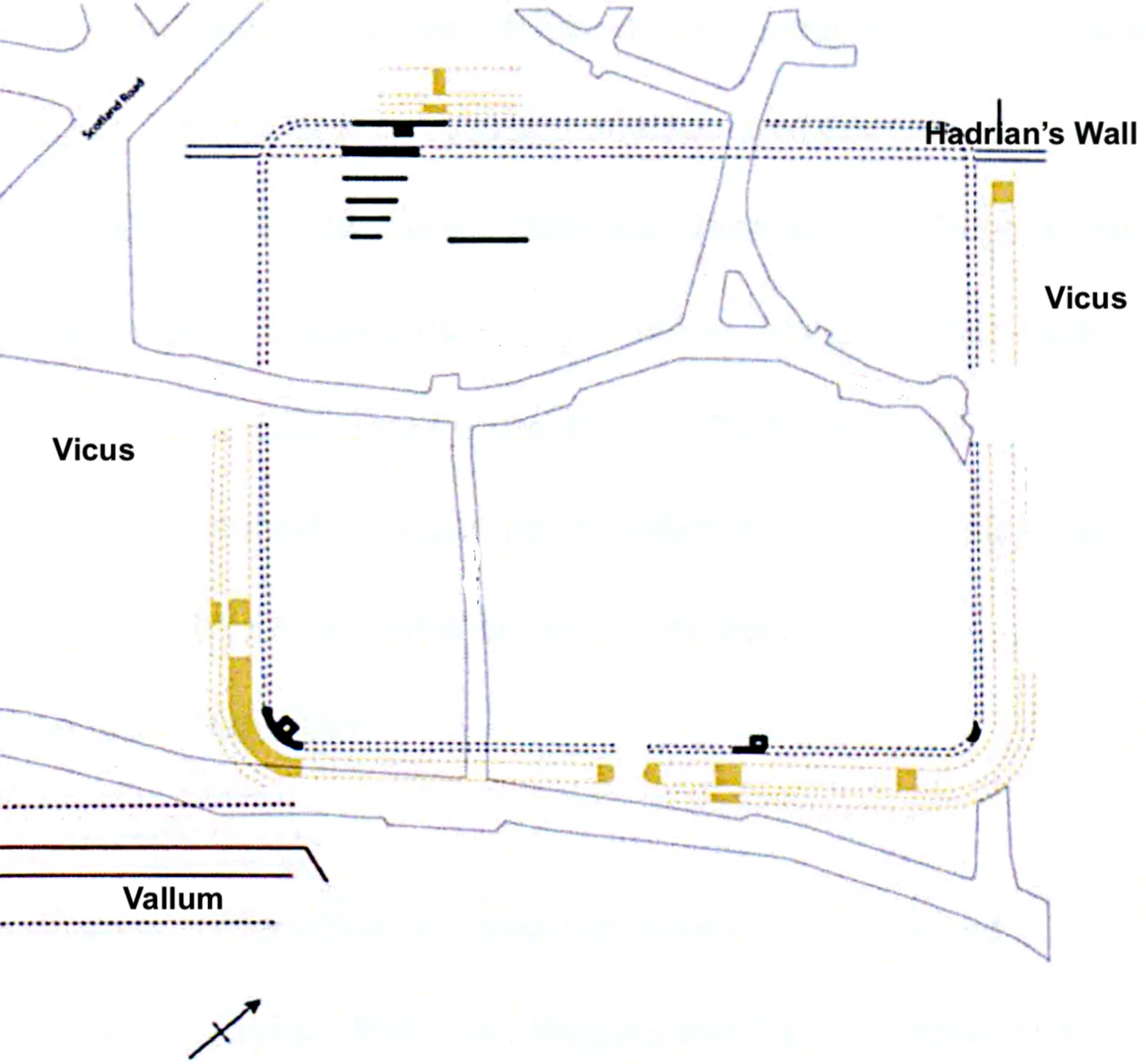
Also known as: Kastell Uxelodunum, Uxelodunum
| Type | Fortress/citadel |
|---|---|
| Period | 1 - 500 AD |
| Country | England |
| Coordinates | 54.9051° N, 2.9419° W |