
 England
Bewcastle Roman Fort was built to the north of Hadrian's Wall as an outpost fort possibly intended for scouting and intelligence [1]. The remains of the fort are situated at the village of Bewcastle, Cumbria, 7 miles to the north of the Roman fort at Birdoswald [1]. The fort was identified as Fanum Cocidi on the basis that, of nine altars discovered on the site, six are dedicated to the god Cocidius [1]. The fort was unusual for a Roman fort, being an irregular hexagon rather than oblong, and occupied the whole of the small plateau on which it stood [1]. The fort was connected to Banna by a Roman road sometimes known by the modern name of the Maiden Way [1]. Two stone signalling towers have been discovered between the two forts, and it is believed that these were used to relay signals between the forts [1]. It is believed that the fort was built at about the same time as the forts on Hadrian's Wall around 124 AD, and that it was originally built with turf defences and timber buildings, but with gates and headquarters of stone [1]. An inscription indicates the fort was built by the Cohors I Dacorum [1].
Text: Wikipedia – 'Bewcastle Roman Fort' (revision of 2026-08-21), CC BY-SA 4.0 · sentences selected and shortened by an AI system · source →Bewcastle Roman Fort
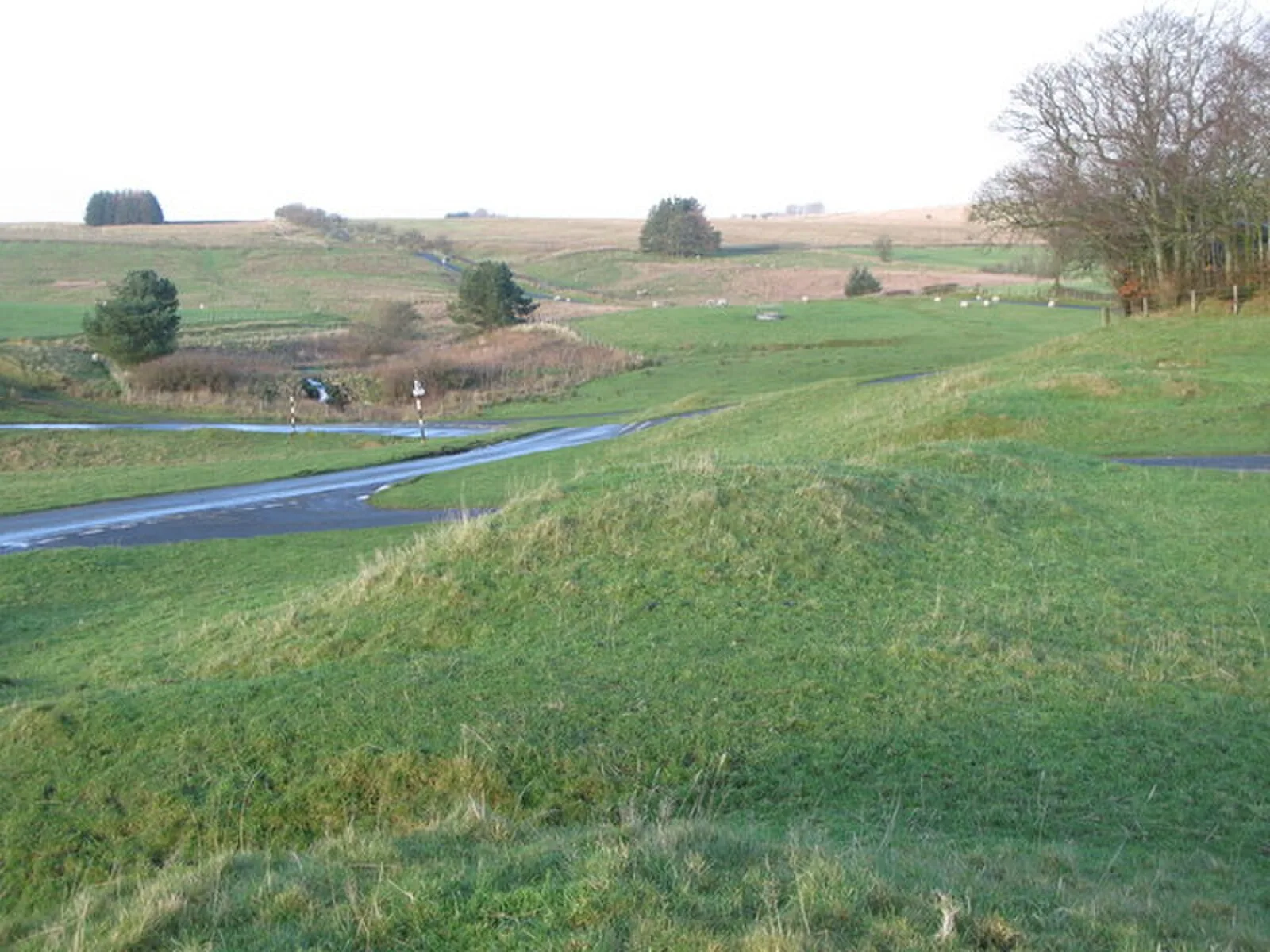
Also known as: Bewcastle, Bewcastle (římská pevnost), Camp romain de Bewcastle, Fanum Cocidi, fort romain de Bewcastle, Fort van Bewcastle
| Type | Fortress/citadel |
|---|---|
| Period | 1 - 500 AD |
| Country | England |
| Coordinates | 55.0641° N, 2.6849° W |