
 England
The Long Man of Wilmington or Wilmington Giant is a hill figure on the steep slopes of Windover Hill near Wilmington, East Sussex, England [1]. It is 6 miles northwest of Eastbourne and 1⁄3 mile south of Wilmington [1]. The Long Man is 235 feet tall, holds two "staves", and is designed to look in proportion when viewed from below [1]. Formerly thought to originate in the Iron Age or even the Neolithic period, a 2003 archaeological investigation showed that the figure may have been cut in the Early Modern era – the 16th or 17th century AD [1]. From afar the figure appears to have been carved from the underlying chalk, but the modern figure is formed from white-painted breeze blocks and lime mortar [1]. For many years the earliest known record was a drawing made by William Burrell when he visited Wilmington Priory in 1766 [1]. In 1993, another drawing was discovered in the Devonshire Collections at Chatsworth House which had been made by the surveyor John Rowley in 1710, the earliest date the figure is known to have existed [1].
Text: Wikipedia – 'Long Man of Wilmington' (revision of 2026-09-16), CC BY-SA 4.0 · sentences selected and shortened by an AI system · source →Long Man of Wilmington
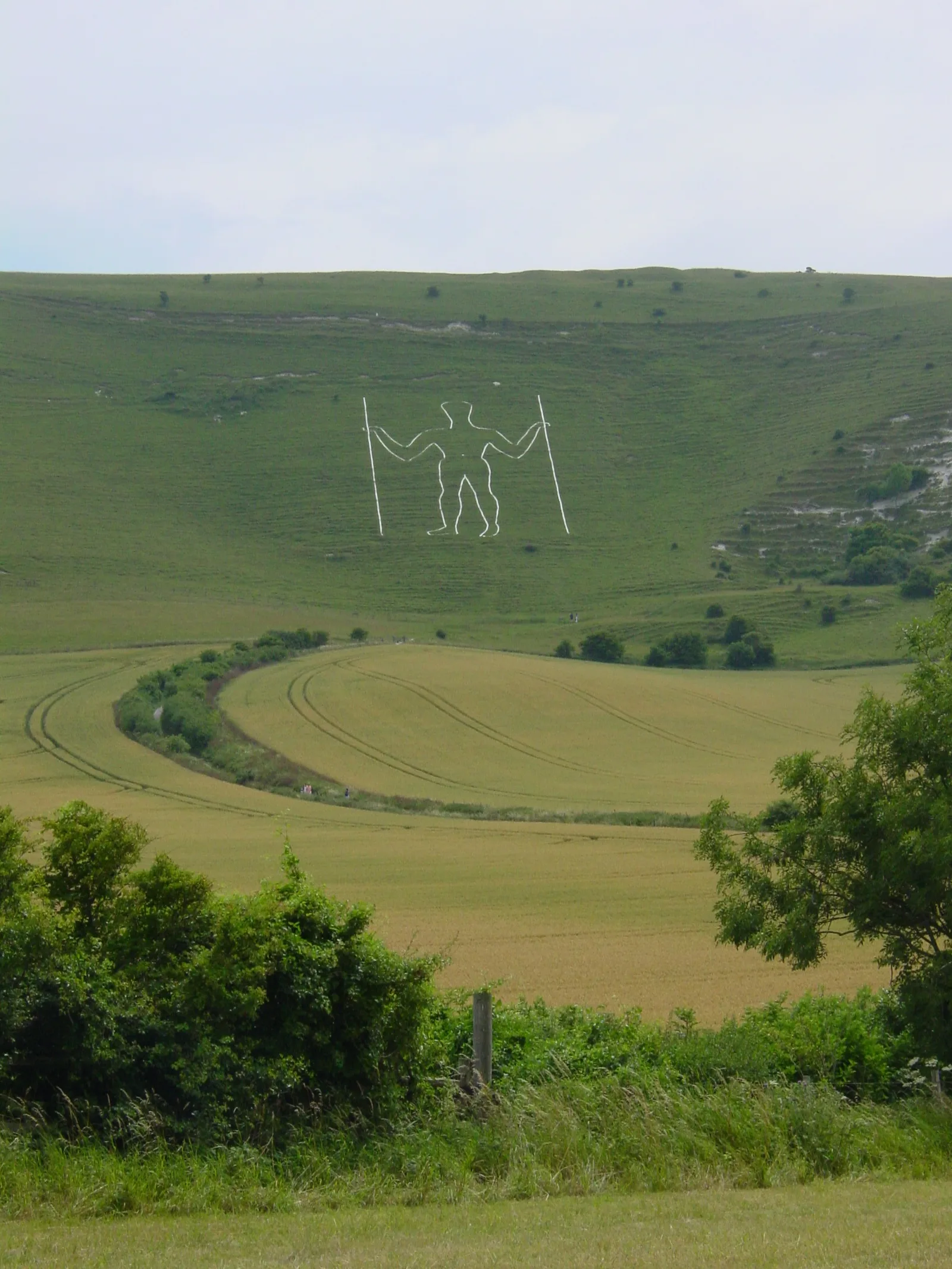
Also known as: 윌밍턴의 롱맨, A turf-cut hill figure known as The Long Man of Wilmington, 914m south-east of Acorn Barn, Długi człowiek z Wilmington, Géant de Wilmington, Hombre Largo de Wilmington, Home llarg de Wilmington, Long Man van Wilmington, Uomo Lungo di Wilmington, Wilmington Uzun Adamı, Длинный человек из Уилмингтона, ウィルミントンのロングマン
| Type | Geoglyphs |
|---|---|
| Period | 1500+ AD |
| Country | England |
| Coordinates | 50.8102° N, 0.1881° E |