
 England
Dubris, also known as Portus Dubris and Dubrae, was a port in Roman Britain on the site of present-day Dover, Kent, England [1]. At the start of his first attempt to conquer Britain in 55 BC Julius Caesar initially tried to land at Dubris, whose natural harbour had presumably been identified by Volusenus as a suitable landing place [1]. Two lighthouses, each called the "Pharos", were built at Dover soon after the Roman conquest [1]. At its peak, Dubris was a major trading centre, taking over from Rutupiae as the main Roman cross-Channel port [1]. With Rutupiae, it was one of the starting points for Watling Street, the Roman road to Canterbury and, ultimately, London [1]. During the construction of the new A256/York Street bypass in the 1970s, Roman remains were discovered and an eight-week excavation followed [1]. The archaeologists discovered a Roman mansio now known as the "Roman Painted House" [1]. Dubris's mansio was demolished in 270 for the construction of a Saxon Shore fort [1].
Text: Wikipedia – 'Dubris' (revision of 2026-04-05), CC BY-SA 4.0 · sentences selected and shortened by an AI system · source →Dubris
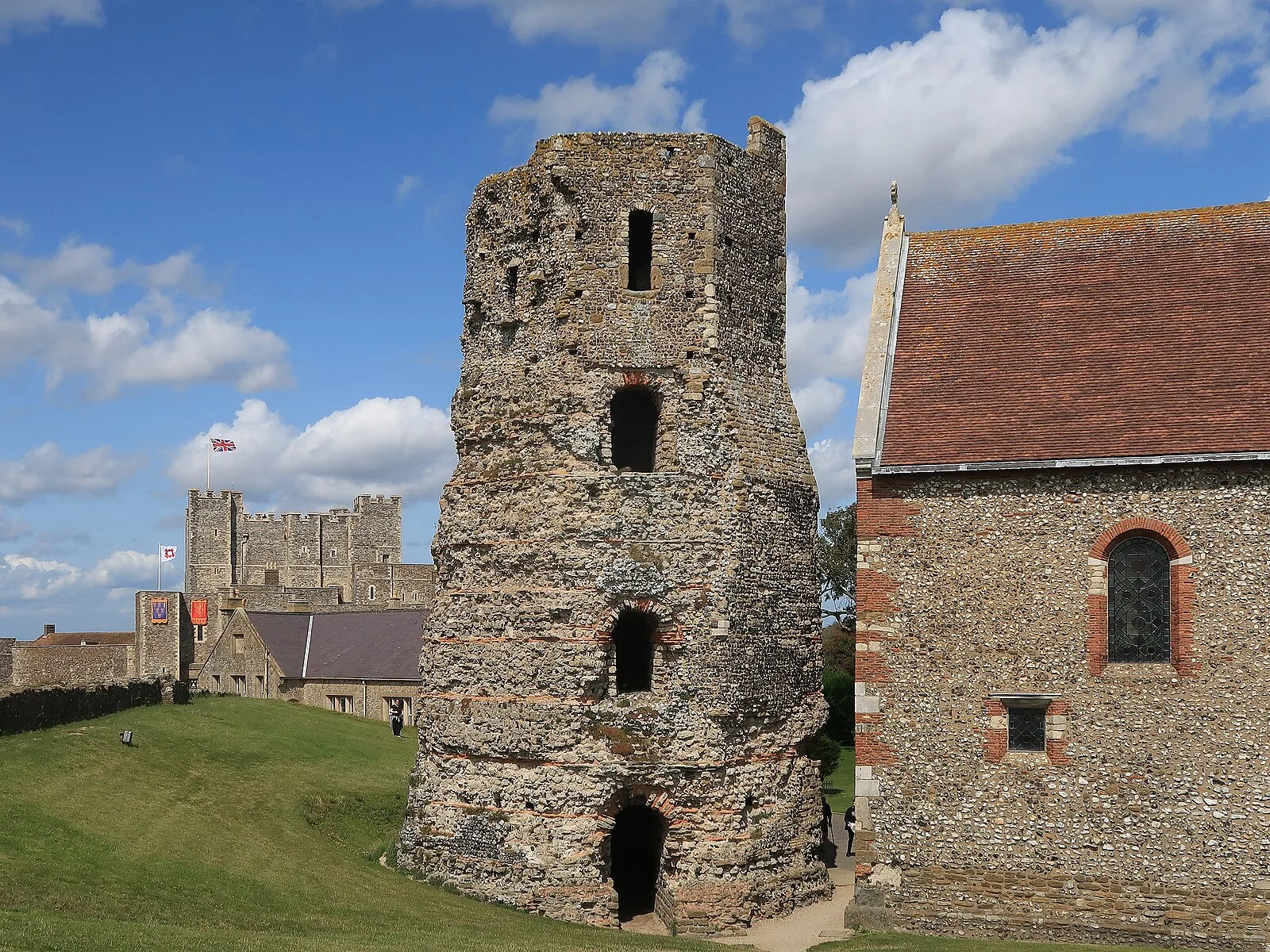
Also known as: Dubrae, Portus Dubris, 度布里斯, 杜布里斯
| Type | City/town/settlement |
|---|---|
| Period | 1 - 500 AD |
| Country | England |
| Coordinates | 51.1287° N, 1.3230° E |