
 England
The Corbridge Lion, Northumberland, England, is an ancient Roman free-standing sandstone sculpture of a male lion standing on a prone animal (possibly a deer) on a semi-cylindrical coping stone base [1]. Measuring 0.95m in length by 0.36m in width and 0.87m high, it was originally a piece of decorative funerary ornamentation from a tomb [1]. It was subsequently re-used as a fountainhead by passing a water pipe through its mouth [1]. It was found in a water tank in 1907 in excavations led by Leonard Woolley on Site II (a corridor building with tesselated floors, hypocausts, and painted wallplaster that has been suggested as a mansio or posting station) on the Roman site at Corbridge [1]. It is believed to date to the 2nd or 3rd centuries AD [1]. The Corbridge Lion is now on display in the Corbridge Roman site museum run by English Heritage [1].
Text: Wikipedia – 'Corbridge Lion' (revision of 2024-02-05), CC BY-SA 4.0 · sentences selected and shortened by an AI system · source →Corbridge Lion
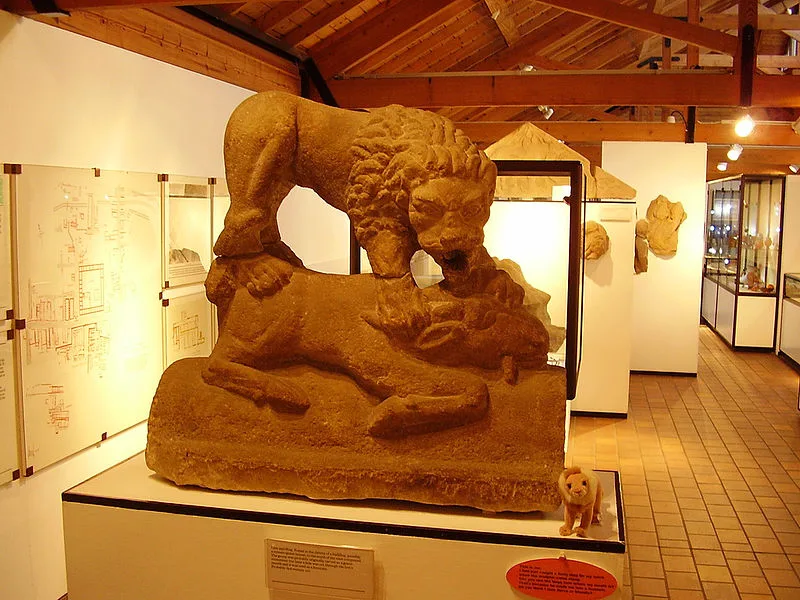
Also known as: Leão de Corbridge, Leone di Corbridge, Lleó de Corbridge, Корбридзький лев, شیر کوربریج
| Type | Rock relief/carving |
|---|---|
| Period | 1 - 500 AD |
| Country | England |
| Coordinates | 54.9782° N, 2.0300° W |