
 England
Aesica (modern name Great Chesters) was a Roman fort, 1.5 miles north of the small town of Haltwhistle in Northumberland [1]. It was the ninth fort on Hadrian's Wall, between Vercovicium (Housesteads) 6.0 miles to the east and Banna (Birdoswald) 6.5 miles to the west [1]. Its main purpose was to guard the Caw Gap where the Haltwhistle Burn crosses the Wall [1]. The fort was rectangular in plan with towers at each corner and measuring 355 feet north to south by 419 feet east to west, occupying a comparatively small area of 3 acres [1]. The fort had three main gates; south, east and west, with double portals with towers [1]. The fort was supplied with water by a remarkable aqueduct system that drew water from the Haltwhistle Burn – Caw Burn directly into the fort [1]. The 2nd-century garrisons were the Sixth Cohort of Nervians, followed by the Sixth Cohort of Raetians [1].
Text: Wikipedia – 'Aesica' (revision of 2026-08-18), CC BY-SA 4.0 · sentences selected and shortened by an AI system · source →Aesica
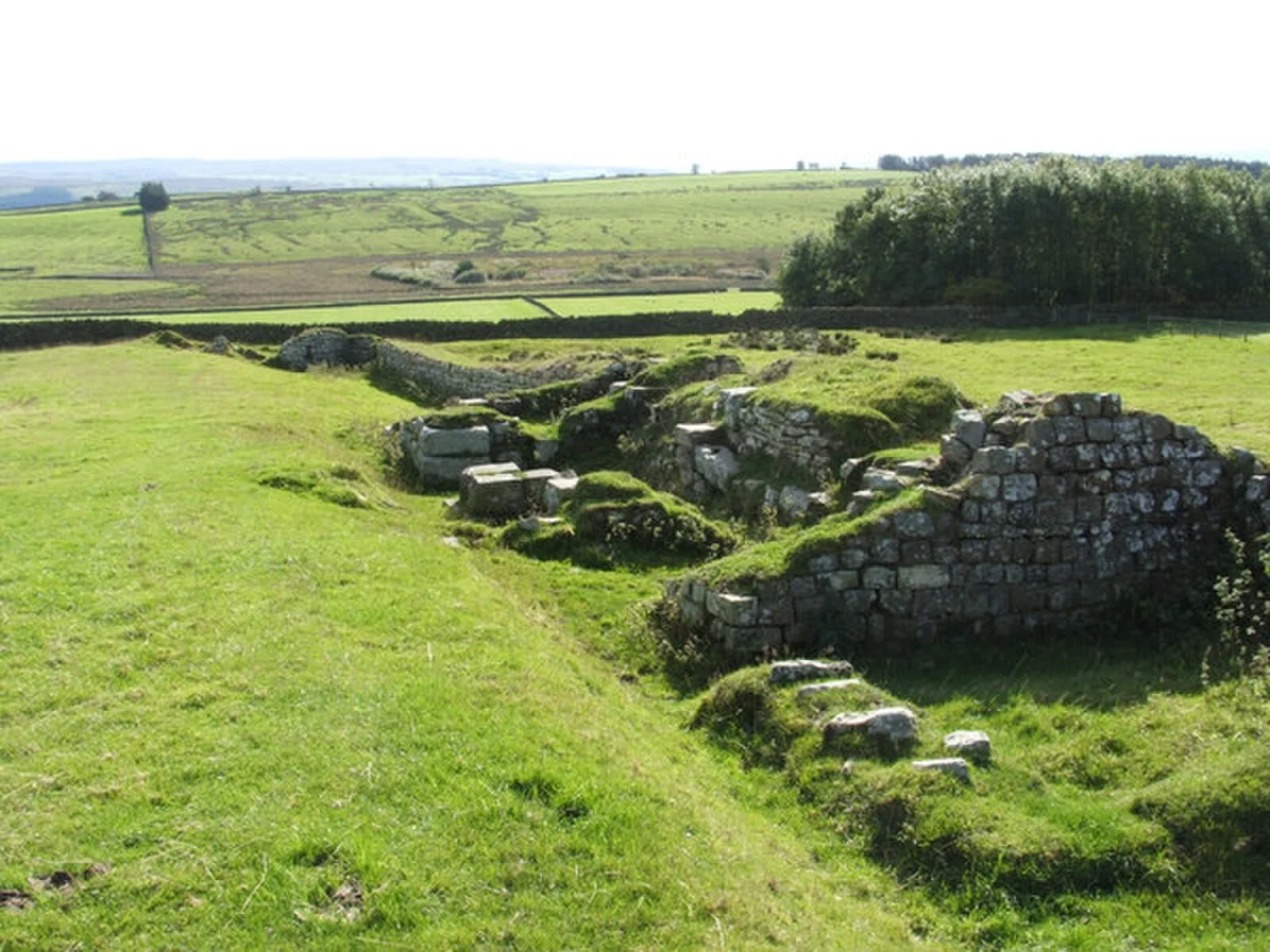
Also known as: Aesica (Great Chesters), Great Chesters, Great Chesters Roman Fort, Great Chesters Roman fort and Hadrian's Wall between the Caw Burn and the track to Cockmount Hill farm in wall miles 42 and 43, Great Chesters (Samian Ware Discovery Site), Kastell Aesica
| Type | Fortress/citadel |
|---|---|
| Period | 1 - 500 AD |
| Country | England |
| Coordinates | 54.9951° N, 2.4641° W |