
 Azerbaijan
The Gobustan Rock Art Cultural Landscape is a historic site in Azerbaijan, comprising a large collection of petroglyphs that reflect the flora, fauna, hunting practices, social structures, and cultural expressions of human societies from prehistoric to medieval times [1]. These engravings provide detailed depictions of anthropomorphic figures, such as lance-bearers and ritualistic dance scenes, as well as various animal species, bullfighting events, camel caravans, and celestial symbols such as the sun and other stars [1]. The Gobustan Rock Art Cultural Landscape reflects the history of human development in Eurasia from the Upper Paleolithic era through the Middle Ages [1]. It is situated at the southeastern end of the Greater Caucasus ridge, approximately 70 km southwest of central Baku, and covers an area of 537 hectares [1]. The rock art was accidentally discovered by quarry workers in the 1930s [1].
Text: Wikipedia – 'Gobustan Rock Art Cultural Landscape' (revision of 2026-07-26), CC BY-SA 4.0 · sentences selected and shortened by an AI system · source →Gobustan Rock Art
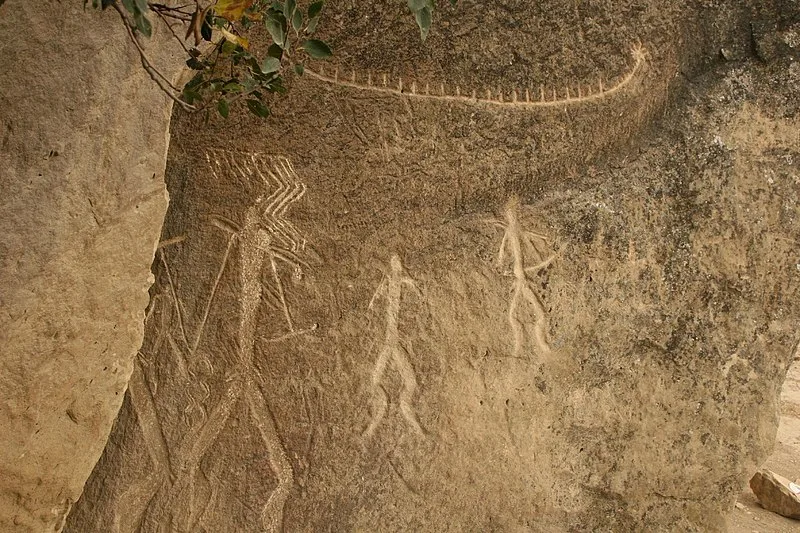
Also known as: Gobustana Rokarto, Gobustan Rock Art Cultural Landscape, Kobustan Petroglifleri, Lanskap Budaya Seni Batu Gobustan, Pajsaġġ Kulturali tat-Tinqix fuq il-Blat f'Gobustan, Pinturas rupestres de Gobustán, Pintures rupestres de Gobustan, qobustani sziklarajzok, qobustani sziklarajzok kultúrtája, Qobustan petroqlifləri, Skalne poslikave in kulturna krajina Gobustana, Гобустандағы тастағы суреттер
| Type | Rock art |
|---|---|
| Period | < 4500 BC |
| Country | Azerbaijan |
| Coordinates | 40.1261° N, 49.3823° E |