
 Spain
SpainCova d'en Daina is a dolmen located near Romanyà de la Selva, in the municipality of Santa Cristina d'Aro, Catalonia, Spain [1]. The dolmen was built out of granite blocks and is dated around 2700–2200 BC [1]. It was discovered by Pere Cama i Casas and the first mention of its uncovering was by Agustí Casas in 1894 [1]. It was later excavated by Lluís Esteva i Cruañas, who unearthed human bones and teeth, flint arrowheads, knife and pottery fragments, and necklace beads [1]. It was partially reconstructed in the 1950s [1]. It is seven metres long and made up of an entrance passage into the funeral chamber, with a circular tumulus that is 11 metres in diameter [1]. The entrance to the tomb is oriented to the southeast, which allows sunlight to reach the interior on the winter solstice [1].
Text: Wikipedia – 'Cova d'en Daina' (revision of 2026-06-30), CC BY-SA 4.0 · sentences selected and shortened by an AI system · source →Cova d'en Daina
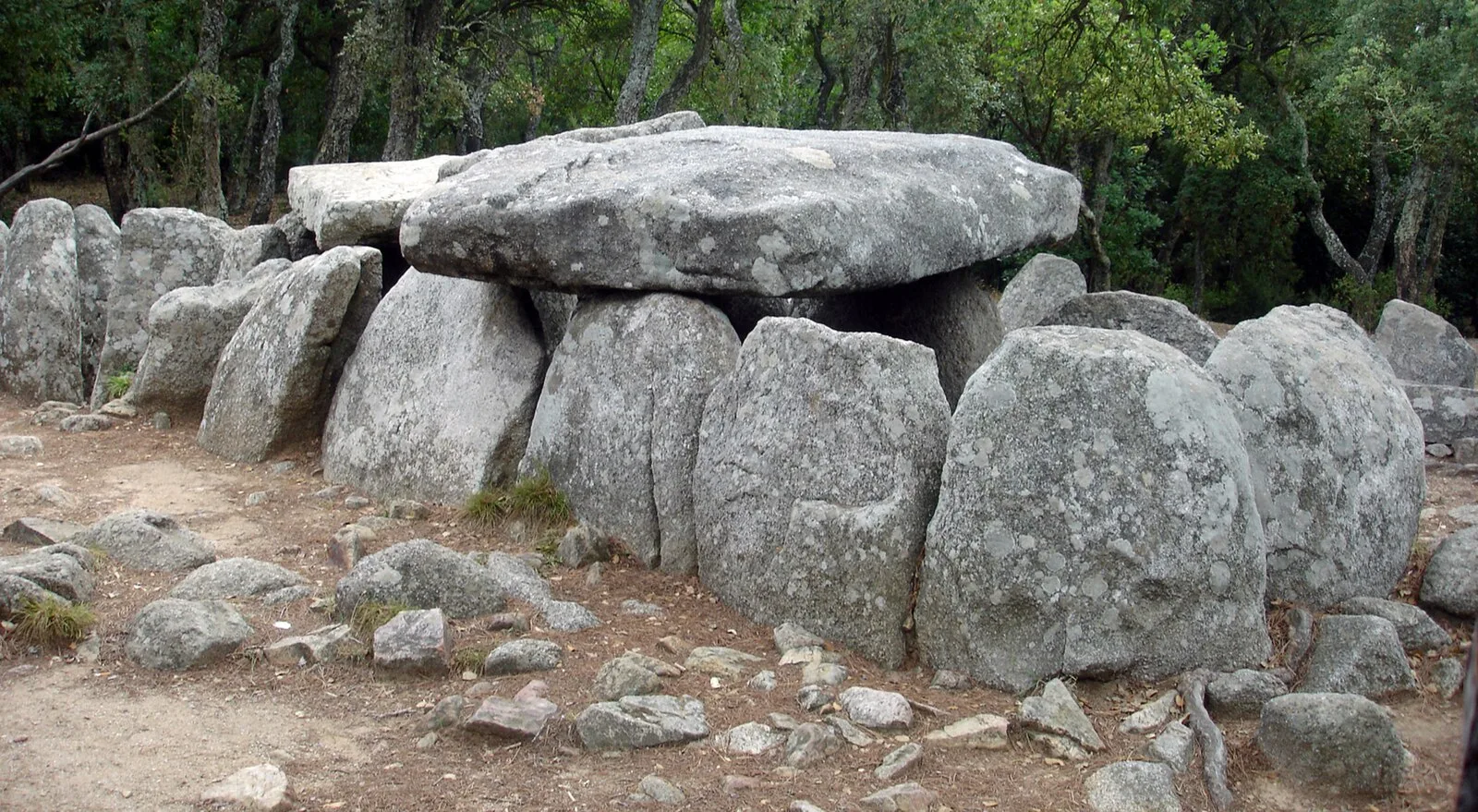
Also known as: cova de la berta, Cueva de Daina, Dainako haitzuloa, Dolmen de la Cova d'en Daina
| Type | Dolmen |
|---|---|
| Period | 3000 - 1500 BC |
| Country | Spain |
| Coordinates | 41.8568° N, 2.9912° E |