
 Spain
SpainClunia (full name Colonia Clunia Sulpicia) was an ancient Roman city [1]. Its remains are located on Alto de Castro, at more than 1,000 metres above sea level, between the villages of Peñalba de Castro and Coruña del Conde, 2 km away from the latter, in the province of Burgos in Spain [1]. The city declined during the 3rd century and was largely abandoned by the Visigothic era [1]. Clunia is a toponym of Arevacian origin [1]. The city of Clunia was founded on a mount a short distance from a Celtiberian settlement called Cluniaco, or Kolounioukou, belonging to the Arevaci, a Pre-Roman tribe that belonged to the family of Celtiberians [1]. Clunia boasted two public baths, a basilica, a forum, many taverns and shops, a theater, and a large temple dedicated to Jupiter [1].
Text: Wikipedia – 'Clunia' (revision of 2026-09-19), CC BY-SA 4.0 · sentences selected and shortened by an AI system · source →Clunia
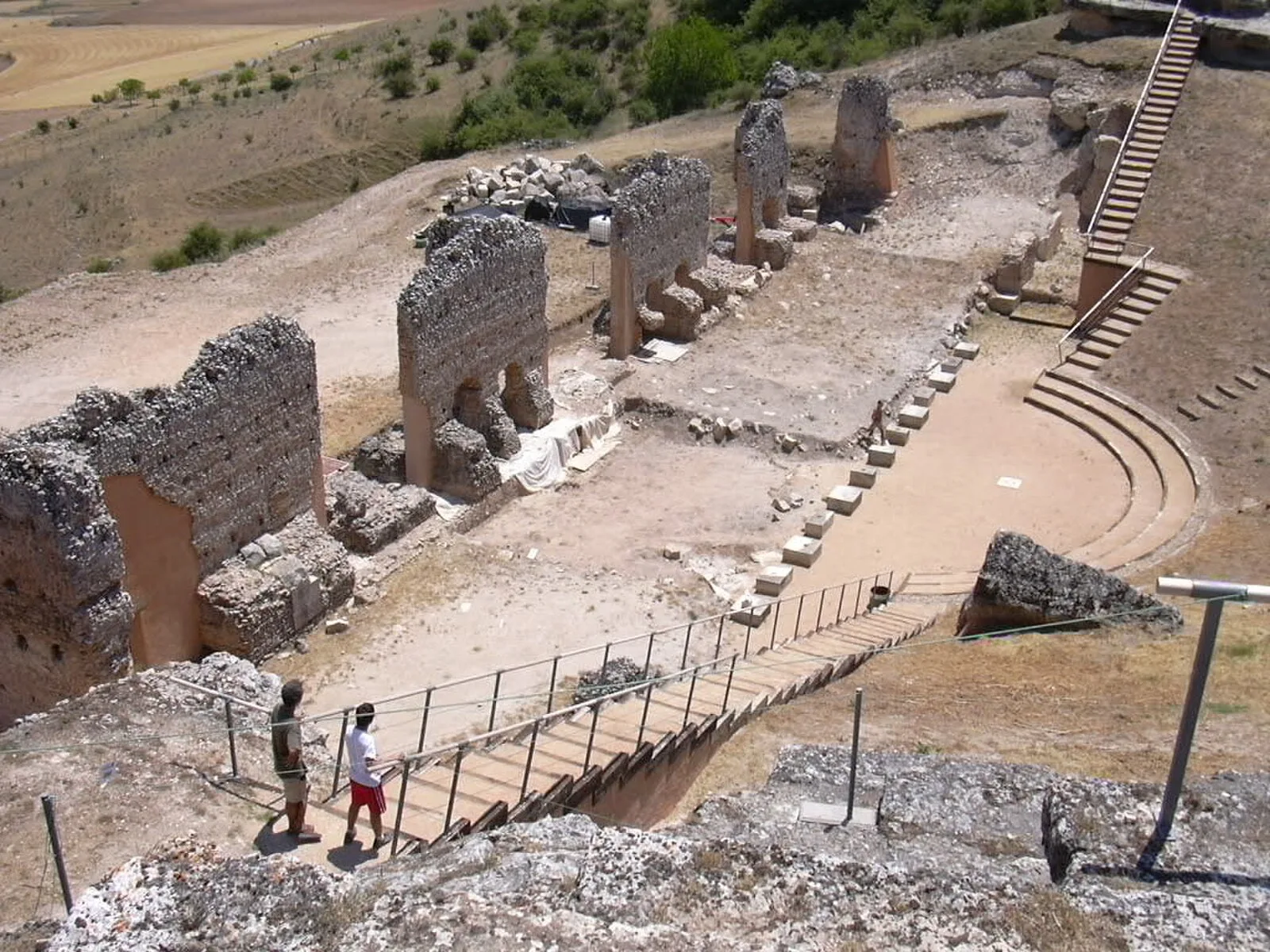
Also known as: Alto del Castro, ciudad romana de Clunia, Clunia Sulpicia, Col. Clunia, Col. Clunia Sulpicia, Col. Clunia Sulpicia/Col. Clunia, Alto del Castro, Peñalba de Castro, colonia Clunia, Colonia Clunia Sulpicia, Klūnija, Kolounioku, Kolounioukou, Peñalba de Castro
| Type | City/town/settlement |
|---|---|
| Period | 500 BC - 1 AD |
| Country | Spain |
| Coordinates | 41.7807° N, 3.3706° W |