
 Spain
SpainThe Aqueduct of Segovia is a Roman aqueduct in Spain, built around the first century AD to channel water from springs in the mountains 17 kilometres to Segovia's fountains, public baths and private houses, in use until 1973 [1]. Its elevated section, with its complete arcade of 167 arches, is one of the best-preserved Roman aqueduct bridges and the foremost symbol of Segovia [1]. As the aqueduct lacks a legible inscription (one was apparently located in the structure's attic, or top portion), the date of construction could not be definitively determined [1]. The general date of the aqueduct's construction was long a mystery, although it was thought to have been during the 1st century AD, during the reigns of the Emperors Domitian, Nerva, and Trajan [1]. The construction of the aqueduct follows the principles laid out by Vitruvius in his De Architectura published in the mid-first century BC [1]. The water was first gathered in a tank known as El Caserón, and was then led through a channel to a second tower known as the Casa de Aguas [1].
Text: Wikipedia – 'Aqueduct of Segovia' (revision of 2026-08-14), CC BY-SA 4.0 · sentences selected and shortened by an AI system · source →Aqueduct of Segovia
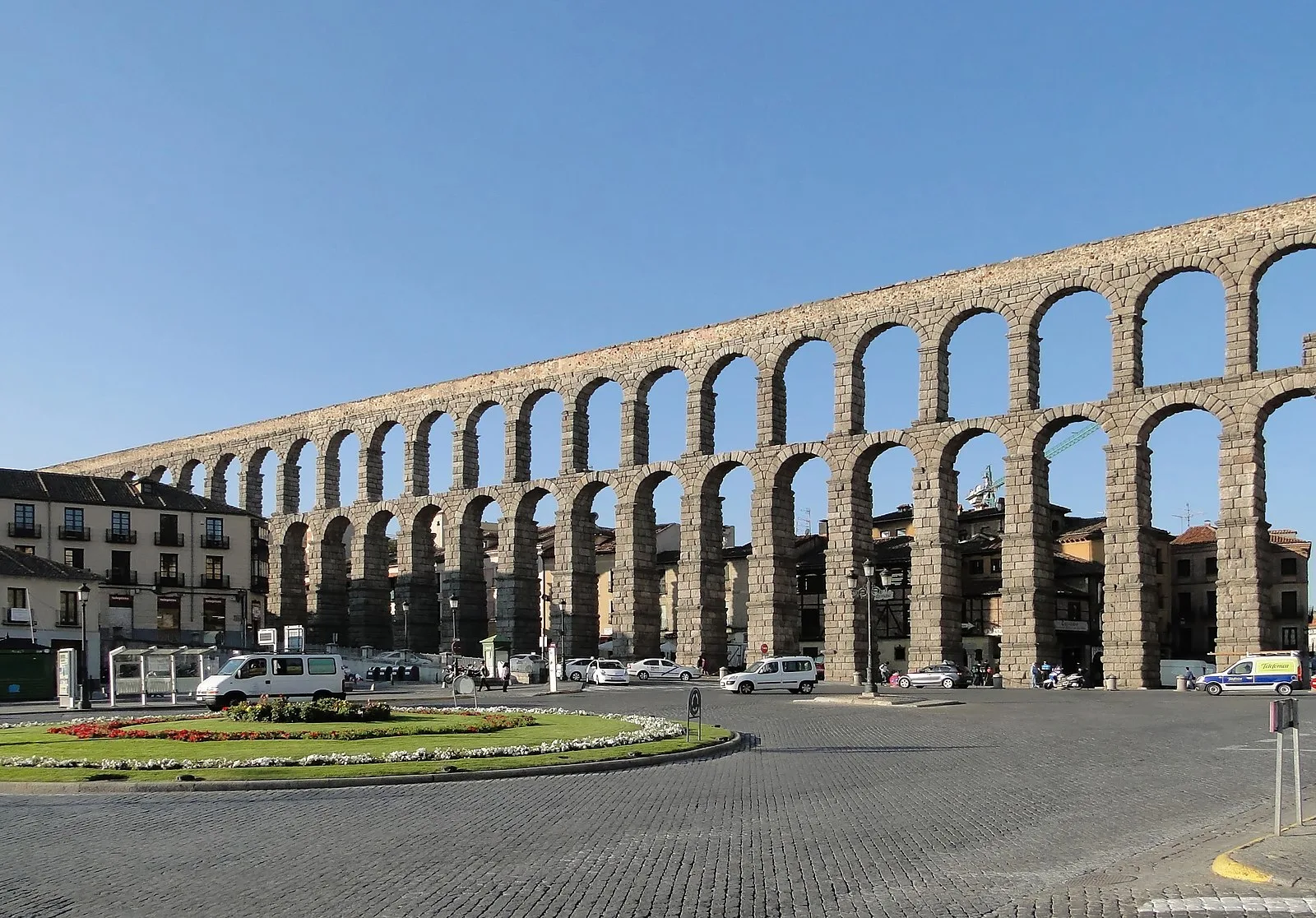
Also known as: 세고비아 수도교, 세고비아 수로교, acquedotto di Segovia, Acuaduto de Segovia, Acueducto Declarado Patrimonio de la Humanidad en 1985 junto con la ciudad antigua., Acueducto de Segovia, Acueducto han Segovia, Acueduto de Segovia, Akuaduk Segovia, Akueduk Segovia, Akvadukt, Akvadukt, Segovia
| Type | Reservoir/aqueduct/canal |
|---|---|
| Period | 1 - 500 AD |
| Country | Spain |
| Coordinates | 40.9482° N, 4.1172° W |