
 Serbia
Roman tomb in Brestovik is an ancient tomb, dating from c. 300, which was discovered in 1895 in Brestovik, today a suburban village of Belgrade [1]. The tomb is situated in the village of Brestovik in Belgrade's municipality of Grocka [1]. It is dug into the hill of Zlatno brdo [1]. The tomb was discovered by accident in 1895 [1]. The structure was built in the late 3rd or an early 4th century [1]. The tomb is oriented in the east-west direction with the entrance being on the eastern side [1]. The walls were covered with frescoes [1].
Text: Wikipedia – 'Roman tomb, Brestovik' (revision of 2025-06-09), CC BY-SA 4.0 · sentences selected and shortened by an AI system · source →Roman Tomb, Brestovik
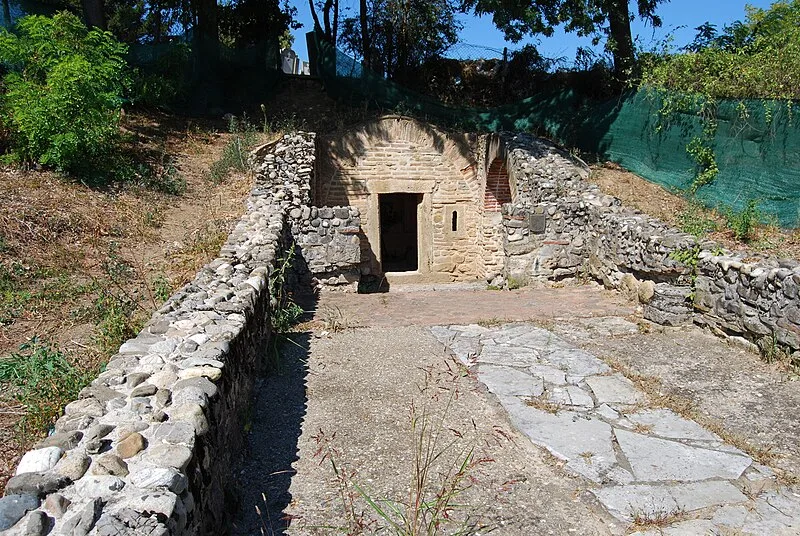
Also known as: Rimska grobnica u Brestoviku, tombe romaine à Brestovik, Римска гробница у Брестовику
| Type | Necropolis/tombs complex |
|---|---|
| Period | 1 - 500 AD |
| Country | Serbia |
| Coordinates | 44.6443° N, 20.7605° E |