
 Portugal
The Roman Dam of Pego da Moura is a small buttress dam situated in the municipality of Grândola in the Setúbal District of Portugal [1]. The dam was constructed during the middle of the Roman occupation of Portugal [1]. Built in two phases, it consists of a rectilinear wall that was originally about 40 metres long [1]. The ruins have a maximum height of 3 m. and a thickness of 2.90 m [1]. There are six downstream buttresses that are 2.50 m. apart, which are around 2.70 m. thick and 2.90 m long [1]. The dam was almost entirely constructed using opus incertum [1]. The dam was first noted by Father Carvalho Costa in 1712 in his work, Corographia Portugueza [1]. However, it was not until the 1990s that a brief archaeological study was conducted [1].
Text: Wikipedia – 'Roman Dam of Pego da Moura' (revision of 2026-07-22), CC BY-SA 4.0 · sentences selected and shortened by an AI system · source →Roman Dam of Pego da Moura
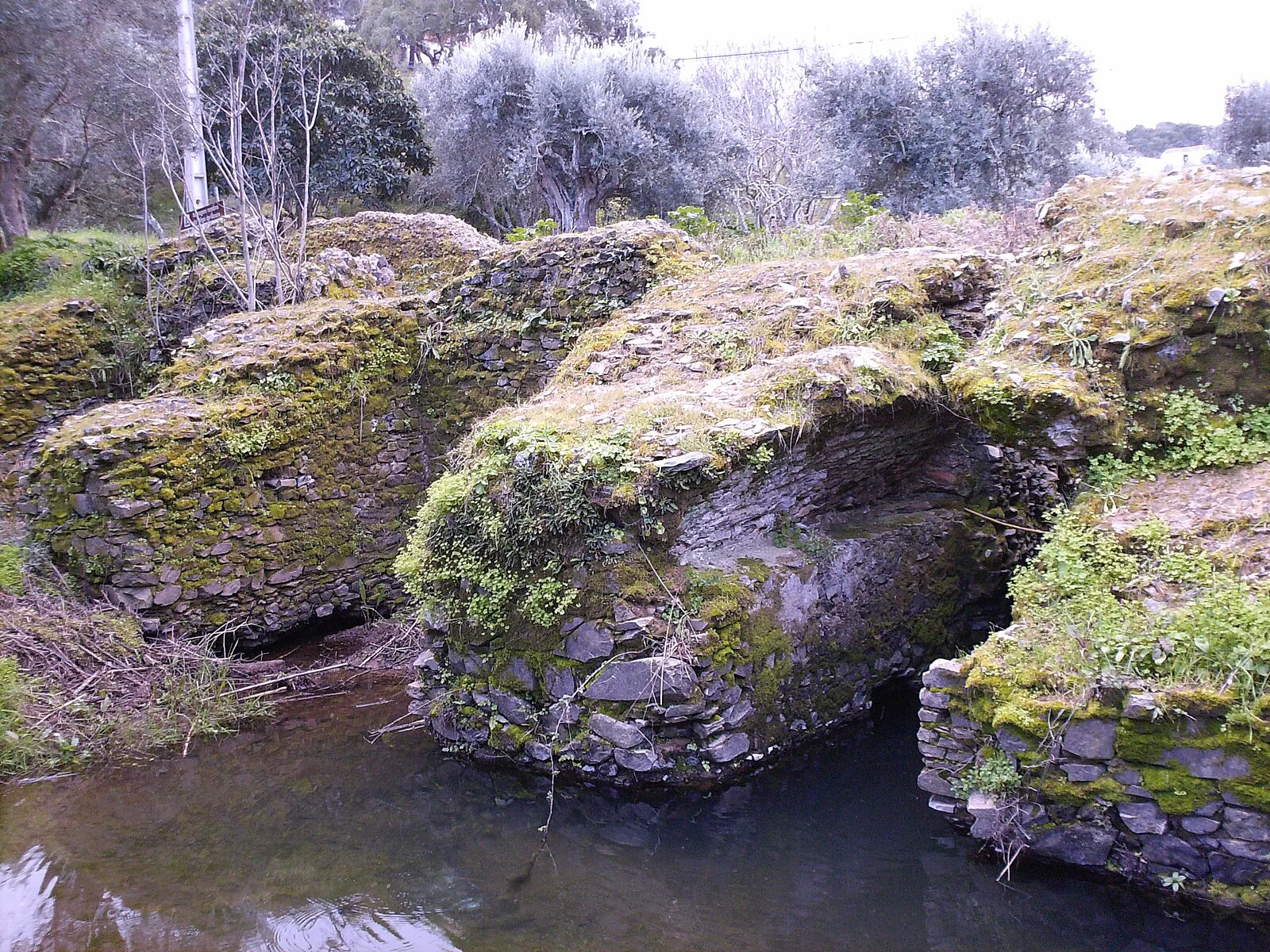
Also known as: Barragem das Represas, Barragem do Pego da Mina, Barragem do Pego da Moura, Barragem Romana do Pego da Moura, Pego da Moura
| Type | Reservoir/aqueduct/canal |
|---|---|
| Period | 500 BC - 1 AD |
| Country | Portugal |
| Coordinates | 38.1551° N, 8.5783° W |