
 Italy
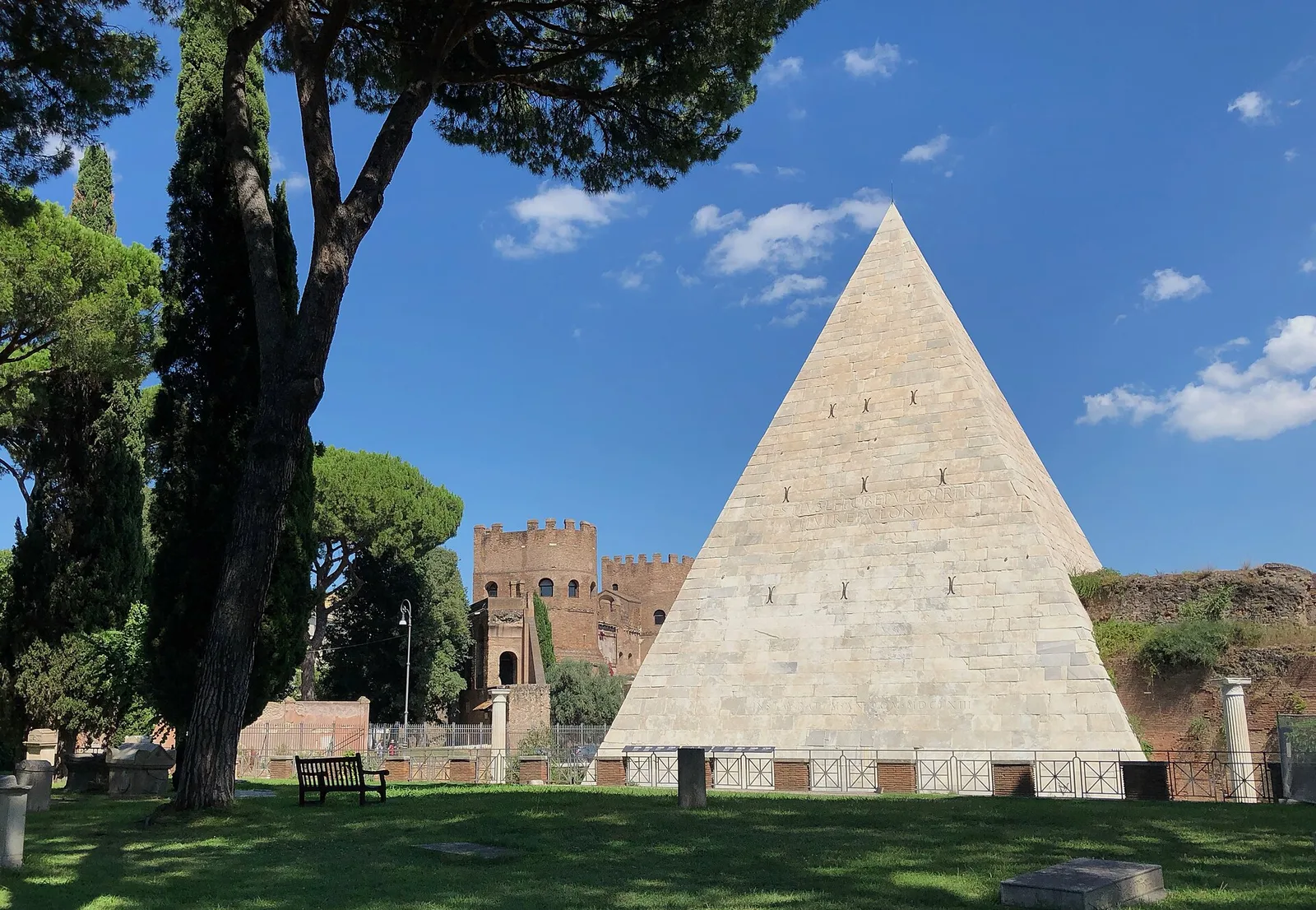
ItalyThe pyramid of Cestius is an ancient Roman pyramid in Rome, Italy, near the Porta San Paolo and the Protestant Cemetery [1]. It was built in the style of the Nubian pyramids as a tomb for Gaius Cestius, a member of the Epulones religious corporation [1]. It stands at a fork between two ancient roads, the Via Ostiensis and another road that ran west to the Tiber along the approximate line of the modern Via Marmorata [1]. The pyramid was built about 18–12 BC as a tomb for Gaius Cestius, a magistrate and member of one of the four great religious corporations in Rome, the Septemviri Epulonum [1]. It is of brick-faced concrete covered with slabs of white marble standing on a travertine foundation [1]. The pyramid measures 100 Roman feet (29.6 m) square at the base and stands 125 Roman feet (37 m) high [1]. In the interior is the burial chamber, a simple barrel-vaulted rectangular cavity measuring 5.95 metres long, 4.10 m wide and 4.80 m high [1]. The tomb was completed in 330 days and was one of two pyramid-shaped tombs in the city of Rome [1].
Text: Wikipedia – 'Pyramid of Cestius' (revision of 2026-09-16), CC BY-SA 4.0 · sentences selected and shortened by an AI system · source →Pyramid of Caius Cestius
Also known as: 세스티우스의 피라미드, Caestiuksen pyramidi, Caius Cestius, Cestijeva piramida, Cestiova pyramida, Cestiuksen pyramidi, Cestius, Cestiuse püramiid, Cestius Piramidi, Cestius piramisa, Cestius pyramid, Cestiuspyramide
| Type | Pyramid complex |
|---|---|
| Period | 500 BC - 1 AD |
| Country | Italy |
| Coordinates | 41.8767° N, 12.4814° E |