
 Greece
The Temple of Aphaia is an Ancient Greek temple located within a sanctuary complex dedicated to the goddess Aphaia on the island of Aegina, which lies in the Saronic Gulf [1]. Formerly known as the Temple of Jupiter Panhellenius, the Doric temple is now recognized as having been dedicated to the mother-goddess Aphaia [1]. Aphaia was a Greek goddess who was worshipped exclusively at this sanctuary [1]. The extant temple of c. 500 BC was built over the remains of an earlier temple of c. 570 BC, which was destroyed by fire c. 510 BC [1]. The last temple is of an unusual plan and is also significant for its pedimental sculptures, which are thought to illustrate the change from Archaic to Early Classical technique [1]. These sculptures are on display in the Glyptothek of Munich [1]. The temple was a hexastyle peripteral Doric order structure on a 6 by 12 column plan resting on a 15.5 by 30.5 m platform; it had a distyle in antis cella with an opisthodomos and a pronaos [1].
Text: Wikipedia – 'Temple of Aphaia' (revision of 2026-07-18), CC BY-SA 4.0 · sentences selected and shortened by an AI system · source →Temple of Aphaia
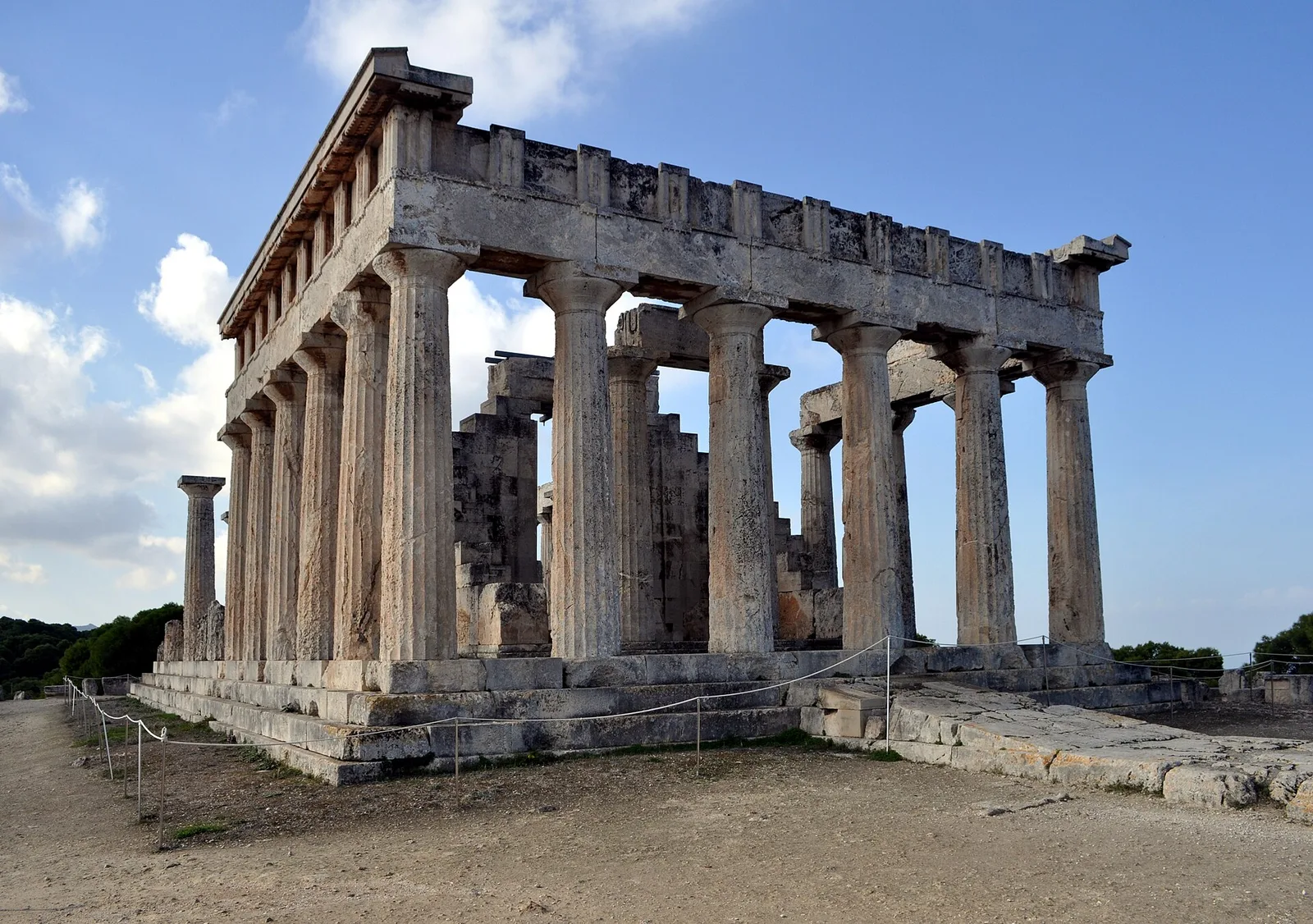
Also known as: Afaian temppeli, Afaiatempelet, Afaiatemplet, Afajin tempelj, Afajin tempelj, Ajgina, Afajos šventykla, Afea Tapınağı, Aphaiatempel, Chrám Afaia, Hram Afaje, Tempio di Afaia, temple d'Afea
| Type | Temple |
|---|---|
| Period | 1500 - 500 BC |
| Country | Greece |
| Coordinates | 37.7543° N, 23.5334° E |