
 Greece
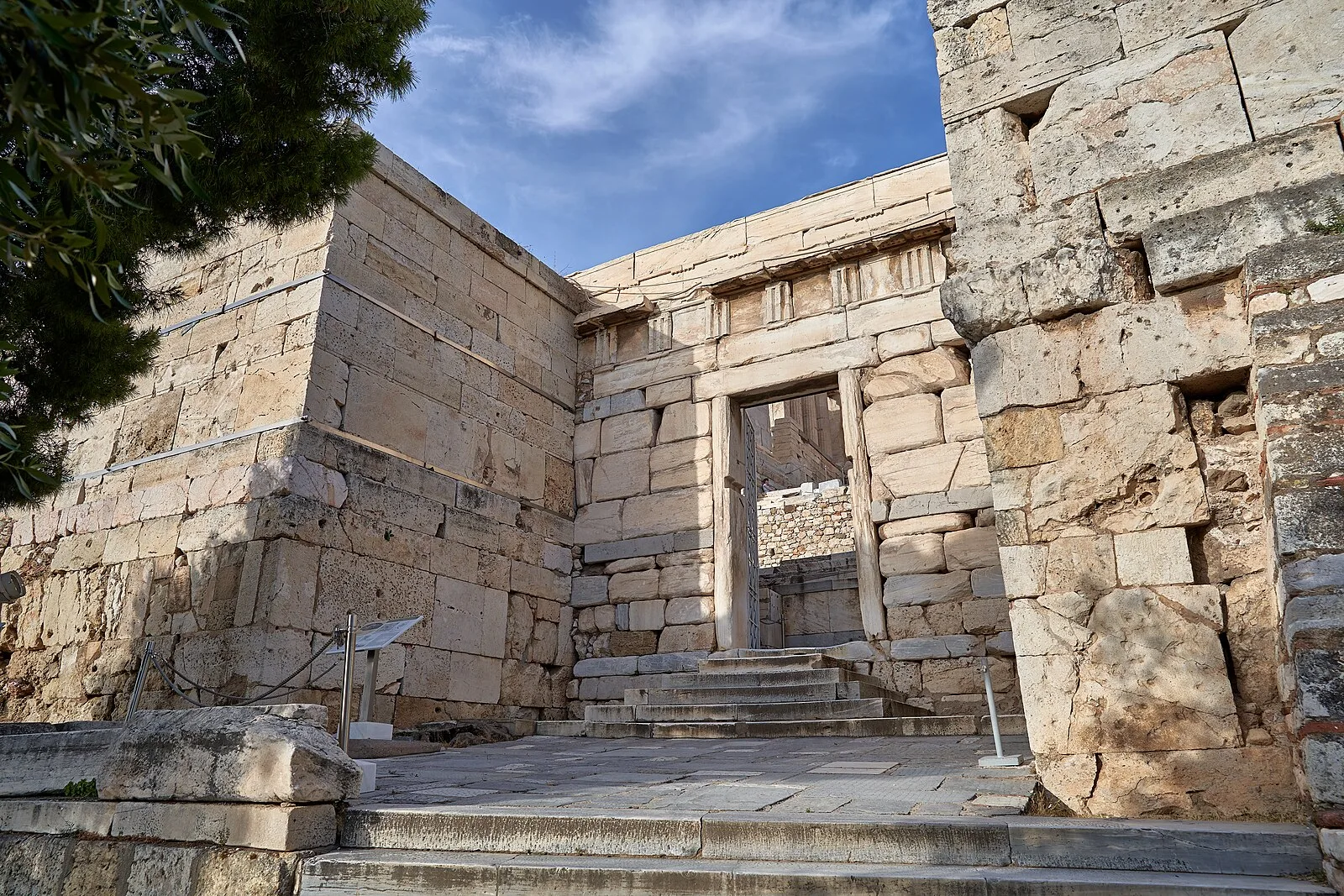
The Beulé Gate is a fortified gate, constructed in the Roman period, leading to the Propylaia of the Acropolis of Athens [1]. It was constructed almost entirely from repurposed materials taken from the Choragic Monument of Nikias [1]. The dedicatory inscription from Nikias's monument is still visible in the entablature of the Beulé Gate [1]. The gate was integrated into the Post-Herulian Wall, a late Roman fortification built around the Acropolis in the years following the city's sack by the Germanic Heruli people in 267 or early 268 CE [1]. During the medieval period, the gate was further fortified and closed off, before being built over with a bastion in Ottoman times [1]. The monument was discovered by the French archaeologist Charles Ernest Beulé in 1852, and excavated between 1852 and 1853 [1]. The gate includes two pylon-like towers, which project around 5 m from the structure [1]. The gate is almost 23 m wide, with a central part around 7 m in both height and width [1].
Text: Wikipedia – 'Beulé Gate' (revision of 2026-08-24), CC BY-SA 4.0 · sentences selected and shortened by an AI system · source →Beulé Gate
Also known as: 베울레 문, Beule Kapısı, Beulén portti, Porta Beulé, porte Beulé, Puerta Beulé, Πύλη Μπελέ, 伯雷門
| Type | Gate/archway/bridge |
|---|---|
| Period | 1 - 500 AD |
| Country | Greece |
| Coordinates | 37.9717° N, 23.7247° E |